College Planning for Physicians: Values First Strategy & Advanced Tactics
July 15, 2026
Welcome to the latest episode of the Physician Cents Podcast, where we explore complex financial topics tailored specifically for physicians. Whether you're a medical student, resident, fellow, or attending physician, you're going to find valuable insights that can help you increase your financial IQ, further your financial journey, and improve your overall well-being. Hosted by Chad Chubb and Tyler Olson, let’s dive in!
Watch this episode instead (Don’t forget to subscribe 🙏):
Listen to this episode instead (Once you love it (we know you will 😉), please leave us a review):
🚨 Looking for help with Disability Insurance, Physician Banking, Student Loan Refinancing, Physician Mortgages, Contract Reviews, and more? Check out our "Best of the Best" sponsors page to find a list of the professionals Chad & Tyler team up with for their clients.
College Savings for Physicians: Choices That Fit
Physicians with children or grandchildren have plenty of ways to save for education. The hard part isn't finding an account. It's deciding what kind of support we want to provide.
Do we want to cover four years of undergraduate tuition? Help with medical school? Give our kids a starting point, while asking them to carry part of the cost? Education savings work best when they fit the whole family plan, not when they become a financial promise we made during a sleepless newborn phase.
Let's start with the family decision, then match the account to the job.
We Should Decide What Educational Support Means Before We Save
Before opening a 529 plan or transferring money into an investment account, we need a target. That sounds obvious. It often gets skipped.
Physicians can earn strong incomes, but our dollars already have many assignments. Retirement contributions, student loans, disability insurance, life insurance, a home, travel, helping parents, and the occasional desire to enjoy life before age 65. College savings belong in that conversation.
A clear goal also requires a real conversation with our spouse or partner. What do we value? How much financial responsibility do we want our children to have? There isn't one correct answer.
Some families want to fund undergraduate school and let graduate education fall on the child. Others want a set amount available for any education path. A family with significant student debt may decide retirement comes first. That's not selfish. That's responsible.
Choose a Target Without Treating It as a Promise
We can save for a percentage of projected in-state tuition, a fixed dollar amount, or a portion of total undergraduate costs. Each approach gives us a practical number without pretending we can predict the next 18 years.
Funding 100% of every possible future expense isn't required. It may not even be wise if it means cutting retirement savings, passing up family experiences, or piling pressure onto ourselves.
College costs change. Scholarships happen. A child may attend community college, take a gap year, receive military benefits, or choose a path that looks nothing like our original spreadsheet.
A college savings target is a direction, not a contract written in stone.
Leave Room for Our Children's Paths to Change
It's easy to look at a bright 5-year-old and picture a future physician, engineer, or Ivy League graduate. We all do it. But education savings should support our children's choices, not become a steering wheel for their lives.
A child may not want the school we imagined. They may not want medicine. They may not use every dollar we saved.
Rigid expectations can turn a generous gift into a source of resentment. We can be proud of planning ahead while leaving room for the person our child becomes.
Why 529 Plans Are Usually the Starting Point for Physicians
For many physician families, a 529 plan is the cleanest starting point. A 529 is an education savings account where investments can grow tax-deferred, and qualified withdrawals are generally tax-free.
Qualified expenses can include tuition, fees, books, supplies, equipment, and certain room and board costs for eligible students. Some K-12 tuition expenses may also qualify, subject to federal and state rules.
Many states offer an income-tax deduction or credit for contributions to their own plan. Those benefits vary a lot. Before opening an account, we should check our state's rules and compare plan costs, investment options, and tax treatment.
If our state doesn't provide a meaningful tax break, the best 529 plan may be outside our home state. Low fees and strong investment choices matter.
Use 529 Flexibility Without Overfunding the Account
A 529 has more flexibility than its reputation suggests. If one child doesn't need the money, we can generally change the beneficiary to another eligible family member. That could include a sibling, grandchild, niece, nephew, or even ourselves in some cases.
Federal rules also allow limited 529-to-Roth IRA rollovers when the account and beneficiary meet the required age, ownership, and contribution rules. This is helpful flexibility, not a reason to stuff unlimited money into a 529.
We should verify the rules before taking a distribution. State tax treatment can differ, and non-qualified withdrawals can trigger income tax plus a 10% federal penalty on earnings.
The bigger risk for many high-income households isn't a penalty. It's putting too much into education accounts while retirement, taxable investing, or family goals need attention.
Understand Contributions, Gift Rules, and Financial Aid
We can contribute more than the annual federal gift tax exclusion, but large gifts may require filing a gift tax return. A 529 also allows a five-year gift-tax election, often called "superfunding," where we front-load five years of annual exclusions into one contribution.
That can be useful for grandparents or physicians making a large early deposit. It can also create estate-planning and reporting issues. A CPA or estate-planning attorney should be part of that conversation.
Financial aid adds another layer. Under current FAFSA rules, parent-owned 529 plans are generally treated differently from grandparent-owned 529 plans. Still, some colleges use the CSS Profile, which asks different questions and may treat outside resources differently.
Grandparent-owned 529s aren't a universal workaround. The school, timing, and aid formula all matter.
How Other College Savings Accounts Compare With a 529 Plan
A 529 plan isn't the only choice. It is often the best education-specific tool, but other accounts can solve different problems.
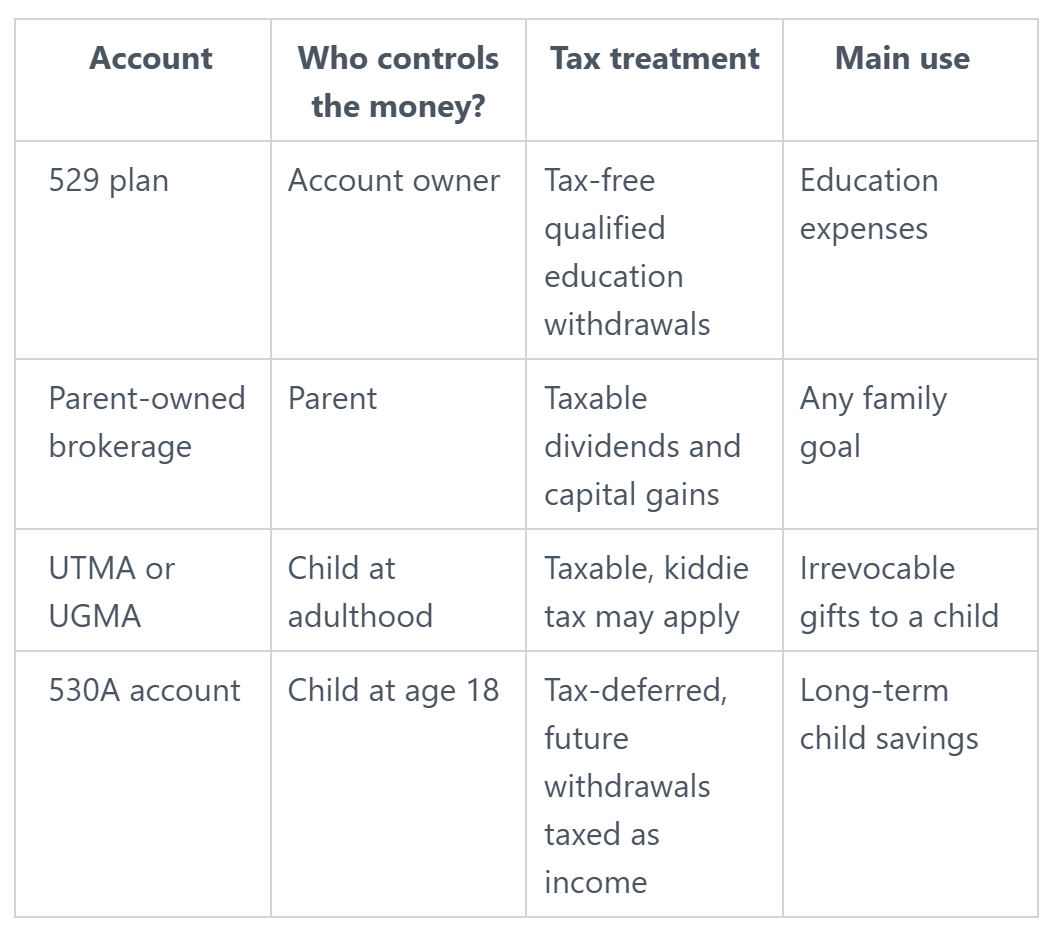
Here's the practical tradeoff:
Control and flexibility are usually more important than chasing a shiny new account type.
A Parent-Owned Brokerage Account Offers Maximum Control
A taxable brokerage account owned by a parent gives us options. We can invest for college, then use the money for a home purchase, a family trip, a business opportunity, or another need if plans change.
The child doesn't automatically gain control at the age of majority. That alone makes a parent-owned brokerage account attractive for families that want flexibility.
The tradeoff is straightforward. Dividends and realized capital gains may create taxes along the way, and there is no special tax break for education withdrawals. A parent-owned brokerage account can also affect financial aid, though its treatment differs from student-owned assets.
For many physicians, the best answer is not either-or. A 529 can cover the education goal, while a taxable brokerage account holds the money we may want access to for anything else.
UTMA and UGMA Accounts Can Create an Unwanted Handoff
UTMA and UGMA accounts are custodial accounts for minors. The money is an irrevocable gift to the child.
That means when the child reaches the age of majority under state law, they generally control the account. They can use it for college. They can also use it for anything legal.
Maybe that's fine for a modest birthday-gift account. It can be much less comfortable when the balance is large and we planned on using it for tuition.
These accounts may also affect financial aid more harshly than parent-owned assets. Tax rules can get complicated too, because the kiddie tax may apply to unearned income. For larger balances, we should get tax guidance before making the gift.
Trump Accounts (530A) Are Better Viewed as Long-Term Child Savings
As of July 2026, Section 530A accounts, often called Trump Accounts, are open for contributions. They are structured as traditional IRA-style accounts for children, not as college savings accounts.
The annual aggregate contribution limit is $5,000 per child. Children born from 2025 through 2028 may qualify for a one-time $1,000 federal contribution. Families must establish the account before money can be deposited.
Funds are generally locked up until age 18. During that growth period, investments are limited to low-cost mutual funds and ETFs that track indexes of primarily U.S. companies. That menu is much narrower than many 529 plans.
At age 18, the account converts to a traditional IRA owned by the child. Education withdrawals may avoid the 10% early-withdrawal penalty, but distributions can still create ordinary income tax.
That makes 530A accounts a separate long-term savings tool. They are not a replacement for a 529 plan when we are saving for college in the next decade or two. Administrative details and federal guidance are still developing, so we should check current IRS information before acting.
How We Can Build and Review a College Plan That Stays Flexible
College saving works better after we cover the foundation. We should first build emergency savings, contribute toward retirement, protect income with disability insurance, maintain appropriate life insurance, and address high-priority debt.
Then we can set a contribution amount that doesn't make the rest of our plan fragile. Tracking separate accounts for each child can make things clearer, especially when ages and goals differ.
A review every year or two is enough for most families. Tax rules, account limits, financial-aid formulas, and 530A guidance can change. Our income and priorities can change too.
Match Contributions to the Time Horizon and Risk
A child with 15 years before college can usually handle more investment risk than a child starting school in two years. That doesn't mean we should gamble with tuition money. It means the investment mix should fit the timeline.
As enrollment gets closer, we should re-examine how much of the account is exposed to market swings. Age-based 529 portfolios can help, but we still need to understand the investment path.
No projected balance is guaranteed. Tuition inflation, scholarships, school choice, and the number of years we fund can all change the math.
Create a Family Conversation About Money and Responsibility
As children get older, we can explain what the education account is for and what it isn't. We might cover tuition but ask them to handle living expenses. We might offer a set dollar amount for any approved path.
Those conversations teach responsibility without turning money into a threat. We can be clear about limits while leaving room for a changed major, a different school, or a different career.
Keep the Plan Bigger Than College
The strongest education plan starts with our values. A 529 is usually the foundation. A parent-owned brokerage account adds flexibility. UTMA and UGMA accounts require caution, and 530A accounts fit better as long-term child savings than near-term college funding.
We don't need to sacrifice retirement or family well-being to give our children a meaningful start. A flexible plan beats a perfect-looking spreadsheet.
As our children grow and our finances change, we can revisit the goal and adjust.
Join the Physician Cents Newsletter for conversations that help us build stronger financial foundations through every stage of a medical career.
The best of the best list is a paid sponsorship, but these are professionals/companies that Tyler and Chad collaborate with within their own practices or have been vetted to earn a spot on this list. By supporting our sponsors, it allows Chad & Tyler to dedicate more time to you and the Physician Cents community. If you ever have a question (or not a great experience, which we don’t expect!) about a sponsor, please let us know. We call it the “best of the best” for a reason, and we will maintain that standard for our listeners & viewers.
This information is for general purposes only. This information is not intended to be a substitute for specific professional financial, tax, or legal advice, as individual circumstances vary. Please see a financial professional, CPA, and/or an attorney in regards to your own individual situation.
Wealthkeel’s Advisory Services and Financial Planning offered through Vicus Capital, Inc., a Federally Registered Investment Advisor. WealthKeel LLC, 615 Channelside Drive, Suite 207, Tampa, FL 33602 -- 267.590.9533.
Olson Consulting LLC, Offering Advisory Services and Financial Planning, is a State-Registered Investment Advisor.
Listen Now:
A podcast designed specifically for physicians, offering a breakdown of complex financial topics to help you develop your financial IQ, further your financial journey, and improve your well-being. Whether you're a medical student, resident, fellow, or attending physician, you're sure to learn something new that will benefit your journey.
.png)

.png)

