How Doctors Can Achieve Financial Freedom: 12 Essential Steps (Part 1)
December 15, 2025
Welcome to the latest episode of the Physician Cents Podcast, where we explore complex financial topics tailored specifically for physicians. Whether you're a medical student, resident, fellow, or attending physician, you're going to find valuable insights that can help you increase your financial IQ, further your financial journey, and improve your overall well-being. Hosted by Chad Chubb and Tyler Olson, let’s dive in!
Watch this episode instead (Don’t forget to subscribe 🙏):
Listen to this episode instead (Once you love it (we know you will 😉), please leave us a review):
🚨 Looking for help with Disability Insurance, Physician Banking, Student Loan Refinancing, Physician Mortgages, Contract Reviews, and more? Check out our "Best of the Best" sponsors page to find a list of the professionals Chad & Tyler team up with for their clients.
How Physicians Can Reach Financial Freedom in 15–20 Years (Part 1: Steps 1–4)
You finish training, your attending paycheck finally hits, and suddenly the numbers in your bank account look completely different.
This is the moment where a lot of physicians accidentally choose between two very different futures:
A path to financial independence in 15 to 20 years
Or a life at 40 with a boat, two BMWs, a seven-figure mortgage, and absolutely zero freedom
This post is Part 1 of a three-part series based on a wildly popular tweet thread from financial planner Tyler Olson, co-host of the Physician Cents podcast. The idea is simple: if you want freedom on your terms, your first few years out of training matter a lot more than you think.
Here, we are walking through Steps 1–4 of his 12-step framework so you can build a rock-solid foundation without feeling like you have to live like a resident forever.
Let’s start with why this whole thing blew up in the first place.
Why This 12-Step Money Plan Hit a Nerve With Physicians
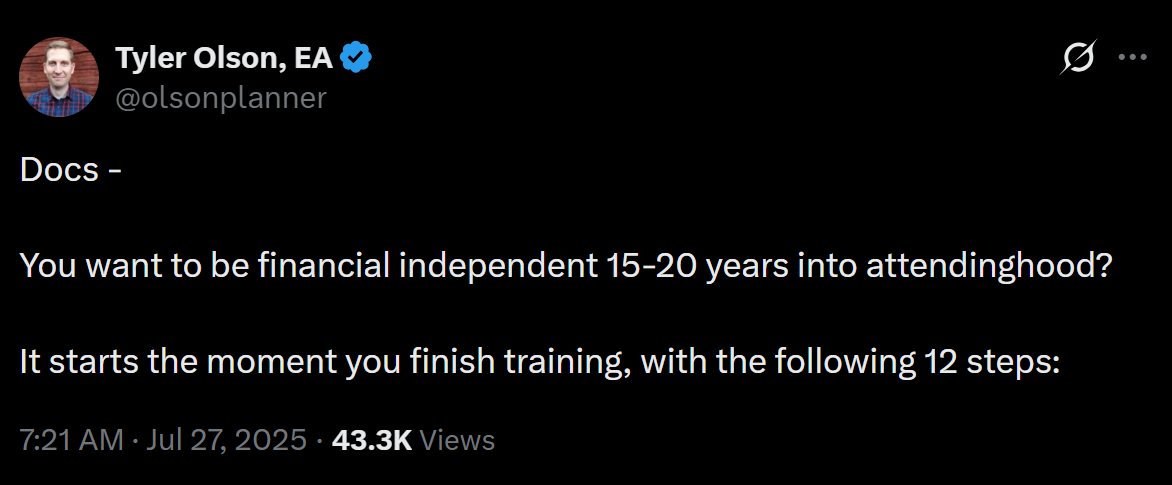
On July 27, Tyler posted a thread that started like this:
“Docs, you want to be financially independent 15 to 20 years into attendinghood. It starts the moment you finish training with these following 12 steps.”
The response was huge:
Over 43,000 views
Close to 500 bookmarks
Around 300 likes
When the bookmarks beat the likes by that much, that tells you something. People are not just casually liking it, they are saving it because it hurts a little and feels very real.
So why did this particular thread hit so hard?
Over the past year, Tyler has talked about meeting more physicians in their 50s who are coming in with big incomes, big houses, big cars, and very small financial freedom. Some of them:
Need to work into their 70s
Or sell their home and uproot their lives in their 50s
All because the early years after training were spent in “I earned it” mode instead of “I’m building my future” mode.
One of the most memorable lines from that thread was this:
“You can build generational wealth in these next three years or wake up at 40 with a boat, two BMWs, a million-dollar mortgage, and zero freedom.”
So, how do you pick the first option? You start with Step 1.
Step 1: Don’t Fall for the “I Earned It” Trap
Here is the heart of Step 1:
“Don’t fall for the I earned it trap. Yes, you did earn it, but upgrading to the $1.2 million house, the G Wagon, the country club right now is like eating dessert before you’ve had dinner. Freedom is greater than flexing. We’ll build the fun stuff after we build your foundation.”
That last line is the key: freedom > flexing.
Why new attendings are so vulnerable here
Think about what is happening when you first become an attending:
You just survived years of training, low pay, and brutal hours
You now carry the final-call responsibility, and that pressure is heavy
You are learning new systems, new hospital politics, new partners, new everything
You finally have attending-level income, and emotionally it feels like:
“I’ve waited long enough. I deserve the house I want. I deserve the car I want. I deserve to feel like I’ve made it.”
So instead of easing into this new money, a lot of physicians sprint straight into:
A house that is 4 times their income
A $90,000 car
A country club membership
Private school before they have looked at the long-term numbers
On paper, the payment “fits.” The paycheck is there. The bank pre-approves the mortgage. The dealer approves the loan. Everything looks fine.
Except it is not fine when:
Kids arrive
School tuition hits
Childcare costs pile up
You start wanting more time off, or a lower FTE, or a different job
Big fixed expenses crush flexibility. You can change a streaming subscription in 30 seconds. You do not casually unwind a $1.2 million mortgage.
What this looks like in real life
You have probably seen some version of this at your hospital:
The “I’ve made it” G-Wagon parked in the physician lot
The Porsche 911 or two BMWs in the driveway
The vanity license plate that screams “Doctor”
Now, to be clear, those things are not automatically bad. Tyler mentioned he has clients with incomes close to $2 million who can own high-end cars without it wrecking their plan.
The problem is when people copy the look without the numbers.
From the outside, all you see is “physician car, physician house, physician lifestyle.” You do not see whether that person is on track for retirement, drowning silently, or working until 75.
And for anyone in a high-cost area like Southern California or New York City, the sticker prices are different, but the math is the same. A $1.2 million house might be “normal,” but you still have to build a plan around your income and your spending. Location does not cancel reality.
Foundation first, fun later
Think about building a house. Nobody shows up on day one and installs the chef’s kitchen, pool, and built-in sound system. They pour the footings. They build the structure. The pretty stuff comes after.
Your financial life works the same way.
The “pretty stuff”:
Fancy car
Dream kitchen
Pool and outdoor kitchen
Country club membership
First-class travel
Those are not off the table. The message is not “never have nice things.” The message is “build your foundation first, then add the fun things on purpose.”
The deeper question is: what do you actually value?
A few examples:
If you love cars but do not care much about travel, maybe the car budget is higher and vacations are modest
If your dream is a big family home with a pool because you want everyone at your house all summer, maybe travel and cars get dialed way down
If you want to work less in your 50s, maybe everything gets dialed back a bit so you can hit financial independence earlier
There is always a tradeoff. You can have almost anything, but you cannot have everything at once.
Step 1 is about protecting future you from early, emotional “I earned it” decisions that quietly lock you in.
Once that mental trap is clear, you are ready for the most unsexy but powerful step in this whole plan.
Step 2: Know Your Number (Track Cash Flow For Real)
Here is Step 2 in one shot:
“Know your number. Before you buy anything, track your cash flow for three months. Not just a rough guess. Actual numbers. Fixed expenses, discretionary burn, savings rate. Most docs think they’re saving. They’re not. Numbers don’t lie.”
Nobody loves this step. You can almost see the energy drop when someone hears “cash flow meeting.” But it is the difference between thinking you are fine and knowing you are fine.
Tools that make this easier
You do not have to create some color-coded, 400-line spreadsheet if that is not your style. You have options:
Monarch Money, which both hosts use and like, pulls in your accounts and gives clean, shareable reports
Tiller pulls your transactions into Google Sheets for a more DIY feel
YNAB and similar apps help with more active budgeting
Or you can go old school with a simple spreadsheet, or even pen and paper
Monarch is especially helpful if you work with a planner, because you can share the data directly. Many of Tyler’s physician clients do exactly that with Olson Consulting LLC, and Chad’s clients do the same through WealthKeel LLC.
The goal is not a perfect system. The goal is awareness.
Money in, money out, and what is left over.
The “dangerously high income” problem
There is a weird zone a lot of physicians fall into. Chad once paraphrased something he heard as:
“Income that is high enough that you do not budget, but not high enough that you can afford not to care.”
For many physicians, that is somewhere in the 300,000 to 600,000 dollar household income range.
What happens in that range:
You can eat out often without thinking
You can travel
You can upgrade furniture, clothes, subscriptions
You can say “yes” to a lot without feeling it day to day
So cash flow tracking feels optional. You might think, “We are maxing the 403(b), maybe the 457(b). We are fine.”
But Tyler has seen households earning more than 500,000 dollars per year that are in trouble:
High spending that nobody can clearly explain
No clear savings beyond retirement accounts
No mid-term savings for things like a future home upgrade, time off, or college
Stress that is way higher than it should be for that income level
This is why Step 2 comes before you set your savings rate. You cannot decide what to save if you do not know where money is actually going.
How to do this without hating your life
Most physicians do not want to sit down every month and categorize every purchase. That is fair.
So use a lighter version:
Pick a 3 month window where life is “normal,” not a one-off vacation month
Pull reports from your main credit card and checking account
Look at broad categories: housing, debt, childcare, groceries, dining out, Amazon/Target, travel, etc.
Then, add one powerful ritual: money dates.
Once a quarter or twice a year:
Sit down with your spouse or partner
Look at what you spent in big categories
Ask, “Are we happy with this?” rather than “Are we in trouble?”
You can also use your paystub as a secret weapon. A lot of physicians have no idea what is happening under the hood. When you break it down:
Federal, state, and local taxes
Social Security and Medicare (FICA)
Retirement contributions
Health insurance, HSA, other deductions
You start to see patterns. For example, that “sudden raise” late in the year is often just the moment you stop paying Social Security. Once you see that, you can plan to capture it for something intentional, like funding next year’s backdoor Roth.
For deeper thinking about physician savings and retirement accounts, Tyler did a Q&A with White Coat Investor that is worth a read: Is Over-Contributing to Your 403(b) Ever a Good Idea?.
Once you know your real number, Step 3 gets a lot easier.
Step 3: Set Your Savings Rate Now (At Your First Big Raise)
Step 3 is where things start to move:
“Set your savings rate now. Your first big pay raise is the easiest time to start saving. Aim for 20–30% of your gross income. Yes, that’s aggressive, but you’re starting late compared to most high earners. Compound growth is your best friend. Every dollar you automate equals less guilt later.”
This is the boundary that protects your future life from your current lifestyle.
Why 20–30 percent is not as crazy as it sounds
If you were a software engineer making six figures at 25, you could maybe save 10 to 15 percent and be fine. As a physician, you start late:
You may not earn attending-level income until your 30s or even 40s
You often have large student loans
You likely want some version of early or flexible retirement
That is why Chad likes 20 percent as the absolute minimum for most physicians who want real flexibility. If you want:
Financial independence in 15 to 20 years
The option to cut back to 0.8 or 0.6 FTE in your 50s
Or a wide-open menu of choices in mid-career
Then 20 to 30 percent of gross income is a very reasonable target.
And remember, this does not all go into a 401(k). That percentage covers:
Taxable brokerage accounts for mid-term and early-retirement goals
That brokerage account becomes the “utility player” of your plan. It can:
Bridge the gap between early financial independence and when your retirement accounts unlock
Fund big mid-term goals
Be a backup layer for emergencies and opportunities
How to actually set and keep that savings rate
Here is a simple sequence:
Do Step 2 and figure out your actual cash flow
Decide what percentage feels aggressive but realistic
Automate contributions so the money leaves your checking account before you touch it
Automation is not just about convenience. It is about behavior. Every automated dollar is one less decision, one less thing to feel guilty about, and one less chance to talk yourself out of saving.
If you get a pay raise, increase your savings rate the same month. If you can live on your old income for a year or two and push the raise straight into savings, you will be way ahead of most of your peers.
Now you have a savings rate. Next step is protecting yourself from the unexpected so you do not have to raid those savings every time life throws a punch.
Step 4: Build Your Cash Moat (Your Emergency Fund)
Step 4 is short and very misunderstood:
“Build your cash moat, aka the emergency fund. Three to six months of expenses in a high-yield savings account. This is not for investing. It’s for sleeping at night when life punches you.”
This is not about math. This is about behavior and sleep.
Why physicians still need boring cash
You will see people online say things like:
“Cash is trash.”
“Invest every dollar.”
“Just use a credit card in an emergency.”
That sounds edgy and interesting on social media. It does not match real life for most physicians who already carry a lot of stress.
A solid cash cushion helps you:
Worry less about market swings
Avoid selling investments at the worst possible times
Handle random stuff without wrecking your plan
Yes, most surprise expenses can be paid with a credit card. But the plan is:
Put the bill on the card if you need to
Pay the card off from your emergency fund
That way you keep your credit clean and your brain calm.
Chad likes an even more conservative take for many early-career physicians: three to six months of after-tax income, not just expenses. That can be very helpful if:
You want the option to leave a toxic job
You might be in between contracts
You are still figuring out your long-term practice fit
The “Level 2” emergency fund
Once your core emergency fund is full, you can create a second layer, what Chad calls the Level 2 emergency fund.
That usually looks like this:
A taxable brokerage account
Invested in a more conservative mix, maybe 50/50 or 60/40 stocks and bonds
Still accessible, but with more growth potential than cash alone
Why bother with this second layer?
Because after a certain point, having a giant pile of cash sitting at low yield starts to hurt you. The Level 2 fund:
Gives your extra safety money a chance to grow
Introduces you gently to investing outside retirement accounts
Adds another buffer for big life events
Real life example: Chad mentioned a dentist client who went on a water slide with her kids, got kicked in the head, ended up with a concussion and a small brain bleed, and has been out of work for months. That is the kind of weird, unplanned event that breaks people who have no margin.
The emergency fund, disability insurance, and smart planning are what keep that from turning into a full-blown financial crisis.
At some point, you also cap this Level 2 fund and send extra money toward long-term investments so you are not forever sitting half in bonds and half in stocks for money you will not need for decades.
The point of Step 4 is simple: when life swings at you, you want a moat, not a puddle.
How Steps 1–4 Work Together To Build Your Foundation
These first four steps are intentionally in order:
Step 1, you avoid the emotional “I earned it” decisions that lock you into huge fixed costs
Step 2, you get honest about your real numbers instead of living in “I think we are fine” land
Step 3, you pick a savings rate that actually matches your goals and late start as a physician, then automate it
Step 4, you build a cash moat so you can handle surprises without blowing up Steps 2 and 3
Once these four pieces are in place, everything else in your plan gets easier. Debt payoff, investing strategy, insurance, college savings, practice ownership, all of it sits on top of this foundation.
If you feel behind, getting help early can change the whole trajectory. Even a one-time plan or short-term engagement with a fee-only planner who understands physicians can save you from some brutal, late-career surprises.
Part 2 of this series walks through Steps 5–8, and Part 3 finishes with Steps 9–12 so you can see the full picture of what Tyler originally laid out.
Wrapping Up: Freedom First, Flexing Later
Those first few attending years are a fork in the road. You can use them to build freedom, or to build a lifestyle that owns you.
If you:
Ignore the “I earned it” trap
Know your cash flow
Set a strong savings rate
And protect yourself with a real cash moat
You give yourself choices. More time with family, earlier financial independence, the option to cut back clinically without panic.
If something in here hit a little too close, that is actually good news. It means you see it early enough to change it.
Thanks for reading. If you want more physician-focused money content, you can check out WealthKeel LLC for more from Chad or connect with Tyler through Olson Consulting LLC.
The best of the best list is a paid sponsorship, but these are professionals/companies that Tyler and Chad collaborate with within their own practices or have been vetted to earn a spot on this list. By supporting our sponsors, it allows Chad & Tyler to dedicate more time to you and the Physician Cents community. If you ever have a question (or not a great experience, which we don’t expect!) about a sponsor, please let us know. We call it the “best of the best” for a reason, and we will maintain that standard for our listeners & viewers.
This information is for general purposes only. This information is not intended to be a substitute for specific professional financial, tax, or legal advice, as individual circumstances vary. Please see a financial professional, CPA, and/or an attorney in regards to your own individual situation.
Wealthkeel’s Advisory Services and Financial Planning offered through Vicus Capital, Inc., a Federally Registered Investment Advisor. WealthKeel LLC, 615 Channelside Drive, Suite 207, Tampa, FL 33602 -- 267.590.9533.
Olson Consulting LLC, Offering Advisory Services and Financial Planning, is a State-Registered Investment Advisor.
Listen Now:
A podcast designed specifically for physicians, offering a breakdown of complex financial topics to help you develop your financial IQ, further your financial journey, and improve your well-being. Whether you're a medical student, resident, fellow, or attending physician, you're sure to learn something new that will benefit your journey.
.png)
.png)

