Beyond the Basics: How Mid-Career Physicians Can Use Wealth to Buy Time & Live More Now
October 1, 2026
Welcome to the latest episode of the Physician Cents Podcast, where we explore complex financial topics tailored specifically for physicians. Whether you're a medical student, resident, fellow, or attending physician, you're going to find valuable insights that can help you increase your financial IQ, further your financial journey, and improve your overall well-being. Hosted by Chad Chubb and Tyler Olson, let’s dive in!
Watch this episode instead (Don’t forget to subscribe 🙏):
Listen to this episode instead (Once you love it (we know you will 😉), please leave us a review):
🚨 Looking for help with Disability Insurance, Physician Banking, Student Loan Refinancing, Physician Mortgages, Contract Reviews, and more? Check out our "Best of the Best" sponsors page to find a list of the professionals Chad & Tyler team up with for their clients.
In this episode, we're digging into Coast FIRE for physicians. It's a framework for answering a question we hear constantly from mid-career doctors: "I've saved diligently for years. Can I ease up without putting retirement at risk?"
Key Takeaways
Coast FIRE means your invested savings could grow toward your retirement goal without large additional contributions.
Reaching your Coast FIRE number does not mean you can stop earning or start spending your retirement portfolio.
Financial flexibility can buy you fewer clinical hours, household help, or more time with the people you care about.
Account types, withdrawal rules, and taxes matter as much as your total balance.
Stress-test your assumptions before changing your schedule, and revisit them as life changes.
What Is Coast FIRE for Physicians?
Coast FIRE is the point where your existing retirement investments are projected to grow to your retirement target on their own, without substantial new contributions. Your current earnings only need to cover today's living expenses.
FIRE stands for "Financial Independence, Retire Early." The "Coast" version is different. It isn't about leaving medicine at 45. It's about taking your foot off the savings accelerator so your portfolio does more of the future work.
The key word is could. Coast FIRE is a planning framework, not a guarantee.
What it means to reach your Coast FIRE number
Your Coast FIRE number is the invested balance that, given reasonable assumptions, is projected to reach your retirement goal by your target date.
To estimate it, you'll need:
Your target retirement date
Expected annual spending in retirement, in today's dollars
An assumed investment return, adjusted for inflation
Inflation and investment fees
Big-ticket future costs, such as healthcare before Medicare, housing, dependents, and taxes
Use consistent assumptions. If you use an inflation-adjusted return, express spending in today's dollars too. Mixing nominal returns with real spending is one of the easiest ways to produce a falsely optimistic answer.
Remember that traditional (pre-tax) retirement withdrawals are generally taxable. A $3 million pre-tax balance doesn't equal $3 million of spending power.
If you haven't put a number on your retirement target yet, start there. WealthKeel's guide on how much you need to retire as a physician walks through a simple planning framework you can use as a foundation.
Why Financial Independence Can Matter More Than Early Retirement
Many physicians genuinely enjoy medicine. What they don't enjoy is the volume: the nights, the call, the inbox, the five-day clinic week.
Reaching your Coast FIRE milestone could support:
Moving to 0.8 or 0.6 FTE
Dropping call or night shifts
Changing roles, such as teaching, administration, or locums
Working by choice rather than necessity
Your paycheck still needs to cover your household's current needs. Coast FIRE changes what you need to save, not what you need to earn.
Avoid the comparison trap
Don't measure your timeline against an unusually high earner who saves enormous amounts every year. Your specialty, student loans, family responsibilities, and cost of living all shape your path.
Chasing the earliest possible retirement date also has costs that never show up on a spreadsheet: missed family time, burnout, and a lower quality of life today. As we talk about on the show, more choice is the goal, not a race to the finish line.
How to Stress-Test Your Coast FIRE Plan Before Cutting Back
A projection can look reassuring simply because its assumptions are reassuring. Give it a tougher test before you hand in a schedule-change request.
Step 1: Run pessimistic scenarios
Model versions of your plan with:
Lower investment returns
Higher spending
A later retirement date
Ask yourself: Does this still work if things don't go my way?
Step 2: Use real spending, not last month's budget
Include irregular expenses like home repairs, car replacements, and family travel. One "good" month is not your true cost of living.
Step 3: Separate retirement money from other goals
Money earmarked for college, emergencies, or a near-term home purchase can't also count toward your Coast FIRE number. The same dollars can't fund several goals at once.
Important: A Coast FIRE projection usually assumes your portfolio stays invested. Spending it to replace lost income changes the math entirely.
Step 4: Get the employment details in writing
A reduced FTE doesn't always mean a proportional reduction in workload. Before committing, clarify:
Call obligations
Inbox and administrative coverage
Productivity expectations
Health insurance eligibility
Retirement plan contributions and employer match
Other benefits tied to FTE status
Get the arrangement documented before you treat the lower salary as your new baseline.
Step 5: Distinguish "on track" from "comfortable"
Being mathematically on track and feeling secure aren't the same thing. A reasonable cash cushion can make a reduced schedule much easier to sustain when life gets expensive.
Use Your Financial Flexibility to Buy Back Time
You don't have to wait for retirement to benefit from financial progress. Sometimes the next dollar buys more breathing room at home than another retirement contribution buys peace of mind.
This idea connects to what WealthKeel calls quiet wealth: using money to buy time and calm rather than status.
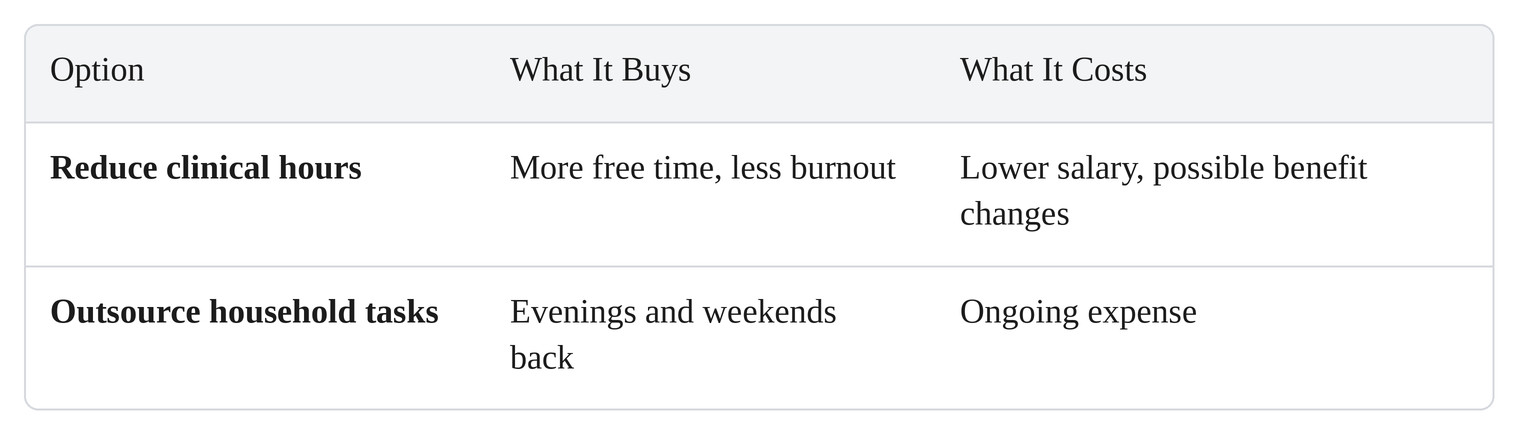
Working less vs. paying for convenience
You generally have two levers:
How to compare them:
Look at after-tax numbers, not your gross hourly rate versus a service quote.
Ask whether the change solves your actual problem. Meal prep won't help much if your biggest frustration is missing bedtime because clinic runs late.
Keep tasks you enjoy. If gardening is recreation, it isn't a chore to outsource.
Give your free time a concrete answer
Before changing your schedule, answer one question: What would I do with a free afternoon?
Then test it now:
Put a recurring activity on the calendar and see whether you look forward to it.
Protect a weekly school pickup.
Restart a hobby or schedule regular time with friends.
You don't need a fully funded retirement to discover that you love hiking or hate planning vacations.
Talk with your household, too. Your ideal schedule may look different from your partner's. A good change fits everyone who shares your time, responsibilities, and budget.
Plan for Taxes and Access to Your Money
A large portfolio doesn't automatically give you usable cash. If reduced work means drawing on investments before traditional retirement age, your account mix matters as much as your balance.
Build a bridge to money you may need before age 59½
Taxable brokerage accounts offer access without retirement-account age restrictions. Selling can still trigger capital gains taxes, and market losses are always possible.
Retirement accounts (401(k), 403(b), traditional IRA): many withdrawals before age 59½ face a 10% additional tax unless an exception applies. The IRS details the rules and exceptions in Publication 590-B.
Before you reduce work, map out:
Which accounts would cover any spending gap
How much cash you have available
What income continues, such as part-time pay or a spouse's salary
You may need no investment withdrawals at all if part-time earnings cover your expenses. That distinction matters, because pausing contributions and taking withdrawals produce very different projections.
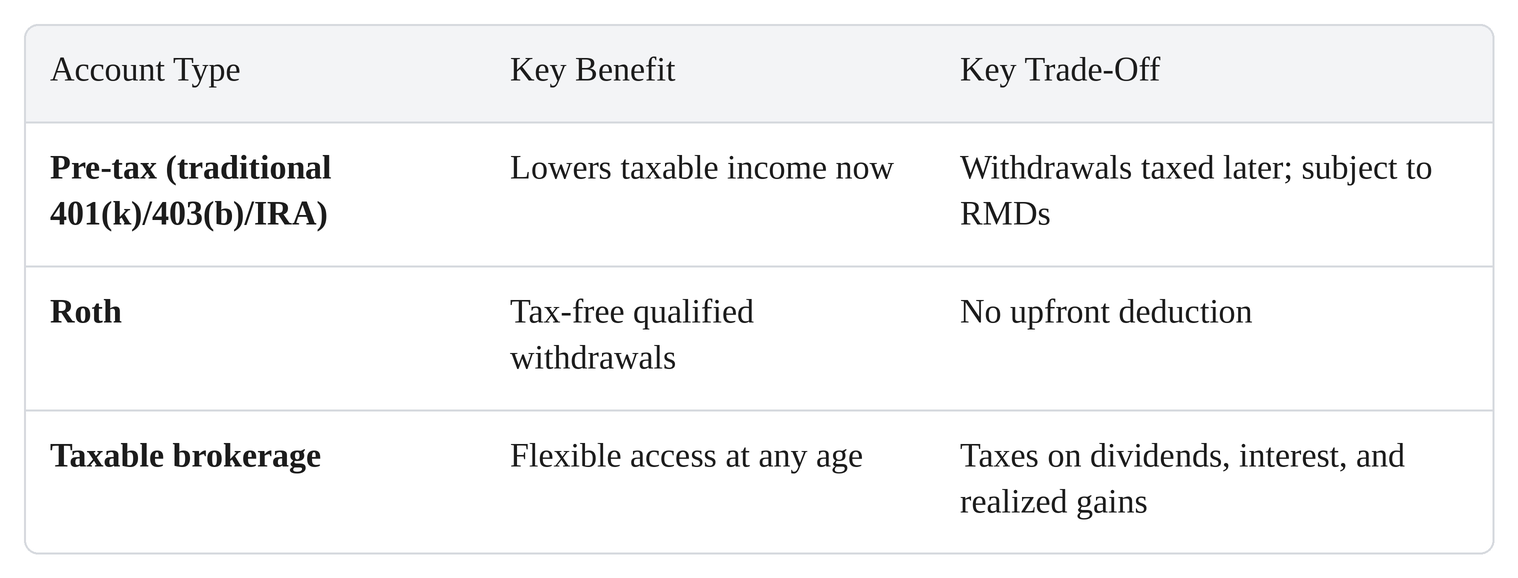
Balance pre-tax, Roth, and taxable investments
The right mix depends on your tax rate today, your expected income later, and when you'll need the money.
Avoid both extremes. Don't dismiss pre-tax savings because future withdrawals are taxable, and don't assume Roth is automatically better. Compare the tax cost now with the expected tax cost later.
Put Your Tax Plan to Work in Lower-Income Years
Watch for future RMDs
A large pre-tax balance can create sizable required minimum distributions (RMDs) later in life. Those withdrawals can push your taxable income up even when you don't need the cash. Your birth year and account type determine when RMDs begin.
Consider Roth conversions when income drops
Cutting back to part-time can create lower-income years, which may be an opportunity for Roth conversions. Keep these points in mind:
A conversion generally adds the converted amount to that year's taxable income.
Plan the tax payment before moving money. Ideally, pay the tax from cash or a taxable account rather than from the converted funds.
A market dip can reduce the dollar value you convert, but nobody knows where the market goes next. Don't build your tax plan around catching the bottom.
Frequently Asked Questions About Coast FIRE for Physicians
1. Should I stop contributing once I reach Coast FIRE?
Not necessarily. Reaching the milestone doesn't require you to stop contributing. An employer match may still be well worth capturing, and continued savings give you a buffer against lower returns or changing goals. Review the full plan before redirecting money, rather than treating the milestone as an automatic stop sign.
2. How should student loans affect my decision?
Student loan payments belong in the budget your reduced income must support. If you're pursuing Public Service Loan Forgiveness (PSLF), confirm employment eligibility before changing hours or employers. Reducing work can affect your forgiveness timeline, not just your monthly cash flow.
3. Does cutting back change my disability insurance needs?
You still depend on your earnings while coasting, so disability insurance often remains important. Review your individual policy and any employer coverage before changing roles or hours. Don't cancel protection just because your retirement projection looks healthy. Your current household expenses still need funding if you can't work.
4. Can one spouse coast while the other keeps saving?
Yes, but the household plan needs to support it. Include both incomes, shared expenses, benefits, and retirement goals in the calculation. Talk through how unpaid household work will shift, too, so the decision feels fair to both partners.
What This Means for You as a Physician
Coast FIRE isn't a finish line. It's a checkpoint that can give you more choice before retirement. That freedom depends on three things:
Realistic projections that survive a pessimistic stress test
Current expenses your reduced income can comfortably cover
A clear plan for taxes and account access
Before reducing work, confirm what the change would cost and how much time it would give back. A sustainable schedule lets your savings keep growing while you enjoy more of the life you've been working so hard to fund.
🎧 Watch the Full Episode
Want the full conversation between Chad and Tyler on Coast FIRE, part-time work, and buying back your time?
The best of the best list is a paid sponsorship, but these are professionals/companies that Tyler and Chad collaborate with within their own practices or have been vetted to earn a spot on this list. By supporting our sponsors, it allows Chad & Tyler to dedicate more time to you and the Physician Cents community. If you ever have a question (or not a great experience, which we don’t expect!) about a sponsor, please let us know. We call it the “best of the best” for a reason, and we will maintain that standard for our listeners & viewers.
This information is for general purposes only. This information is not intended to be a substitute for specific professional financial, tax, or legal advice, as individual circumstances vary. Please see a financial professional, CPA, and/or an attorney in regards to your own individual situation.
Wealthkeel’s Advisory Services and Financial Planning offered through Vicus Capital, Inc., a Federally Registered Investment Advisor. WealthKeel LLC, 615 Channelside Drive, Suite 207, Tampa, FL 33602 -- 267.590.9533.
Olson Consulting LLC, Offering Advisory Services and Financial Planning, is a State-Registered Investment Advisor.
Listen Now:
A podcast designed specifically for physicians, offering a breakdown of complex financial topics to help you develop your financial IQ, further your financial journey, and improve your well-being. Whether you're a medical student, resident, fellow, or attending physician, you're sure to learn something new that will benefit your journey.
.png)


.png)

