Physician Side Hustles & Moonlighting in 2026: Extra Income Without Burning Out
August 1, 2026
Welcome to the latest episode of the Physician Cents Podcast, where we explore complex financial topics tailored specifically for physicians. Whether you're a medical student, resident, fellow, or attending physician, you're going to find valuable insights that can help you increase your financial IQ, further your financial journey, and improve your overall well-being. Hosted by Chad Chubb and Tyler Olson, let’s dive in!
Watch this episode instead (Don’t forget to subscribe 🙏):
Listen to this episode instead (Once you love it (we know you will 😉), please leave us a review):
🚨 Looking for help with Disability Insurance, Physician Banking, Student Loan Refinancing, Physician Mortgages, Contract Reviews, and more? Check out our "Best of the Best" sponsors page to find a list of the professionals Chad & Tyler team up with for their clients.
Extra income sounds simple. It usually isn't.
A physician side hustle gets pitched to us constantly, by clients, on social media, in casual conversation, as an easy lever to pull. Pick up a few extra shifts. Take on some 1099 work. Watch the income climb.
We don't think it's that simple, and this isn't going to be a list of "best side hustle ideas." What we actually want to walk through is everything that comes with the side hustle: the business structure decisions, the liability questions, the tax mechanics, and the retirement opportunities that most physicians don't think about until they're already in the middle of it.
Why so many physicians are chasing extra income right now
This conversation keeps showing up for a reason. Physician pay hasn't kept pace with inflation the way it should have. Student loans are still a heavy lift for anyone not tracking toward PSLF, and that pressure isn't easing up as federal loan limits shrink and private loans fill more of the gap. And then there's burnout, which sits around 55% of physicians by most estimates. For a lot of doctors, a side hustle isn't really about the extra dollars. It's an attempt to claw back some autonomy over how and where they work.
That distinction matters. A side hustle chosen to fight burnout needs to be evaluated differently than one chosen purely to chase income, because the wrong version of "extra work" can make burnout worse, not better.
The FOMO is real. So is the workload.
There's a lot of excitement around 1099 income right now, some of it earned, some of it inflated by physicians on social media showcasing the highlight reel. We don't want to talk you out of that excitement. Done well, 1099 income can lower your lifetime tax bill, add real income, and give you genuine autonomy.
But it helps to lose the rose-colored glasses. Taking on 1099 work means starting a business, even a small one, and that comes with real tax exposure, benefit decisions you now have to make yourself, and professional liability considerations that didn't exist when someone else was handling your paycheck. It's a lot like the romanticized version of real estate investing: it can work out beautifully, but nobody wakes up living the highlight reel the day after they decide to try it. It takes organization to build and maintain.
We've seen clients start down this road and watch it get complicated fast, once every hour spent managing the new gig gets priced in at their actual hourly rate. That's the piece that's easy to skip: your time as a physician is expensive, and a side hustle's "return" looks a lot different once you account for what your hours are actually worth. None of that means it isn't worth doing. It usually just means the first stretch is heavier than people expect, and it gets easier once the structure is in place.
If your employer wants to switch you from W-2 to 1099
One scenario worth flagging on its own: your employer approaches you about converting your role from W-2 to 1099. Pay close attention here. An employee role isn't technically supposed to be interchangeable with a 1099 role, and this kind of request can raise a Department of Labor misclassification issue, on your employer's side, not yours. In practice, enforcement is rare. But it still tells you something about how that employer is thinking about the relationship.
If this happens to you, or you're comparing a W-2 offer against a 1099 offer for similar work, you're now covering costs your employer used to absorb: their share of payroll taxes, malpractice and possibly tail insurance, health insurance, and disability insurance. A useful rule of thumb is that 1099 pay should run at least 20 to 25% higher than the equivalent W-2 rate to actually come out ahead. If you were making $400 an hour as an employee, you'd want to be closer to $500 an hour as a contractor before the math genuinely works in your favor.
When it's actually worth formalizing your side income
We get this question constantly: at what point do you go from "I have some 1099 income" to setting up a real business structure? An EIN, an LLC, maybe even an S-corp election?
The honest answer has less to do with a specific dollar figure and more to do with how long you expect to keep doing the work. A single year of 1099 income probably doesn't need an LLC. But ongoing income, even a modest $25,000 to $30,000 a year, is often worth formalizing, largely because it opens the door to a Solo 401(k), where you can put away roughly 20% of your net 1099 income for retirement, on top of whatever you're already contributing through your main job.
One small administrative wrinkle worth knowing: several custodians, Fidelity included, now require a dedicated EIN rather than just your Social Security number to open a Solo 401(k). And if you're eyeing something more advanced, like a mega backdoor Roth or a cash balance plan, most standard custodian platforms aren't built to handle it. That typically means working with a separate provider set up specifically for those strategies.
Why an S-corp isn't automatically the right move
A lot of the social media chatter around 1099 income jumps straight to "just set up an S-corp," and we'd slow that down. When you're operating as a sole proprietor or a simple pass-through LLC, you likely qualify for the Qualified Business Income (QBI) deduction, which lets you deduct 20% of your net business income on your personal return.
Once you elect S-corp status, you're required to run payroll and pay yourself a reasonable salary. That salary is a business expense, which shrinks your net business income, which shrinks the base the QBI deduction applies to. The trade-off is that an S-corp can reduce FICA taxes on whatever income comes through as a distribution instead of salary. Whether that trade-off is worth it depends heavily on the numbers.
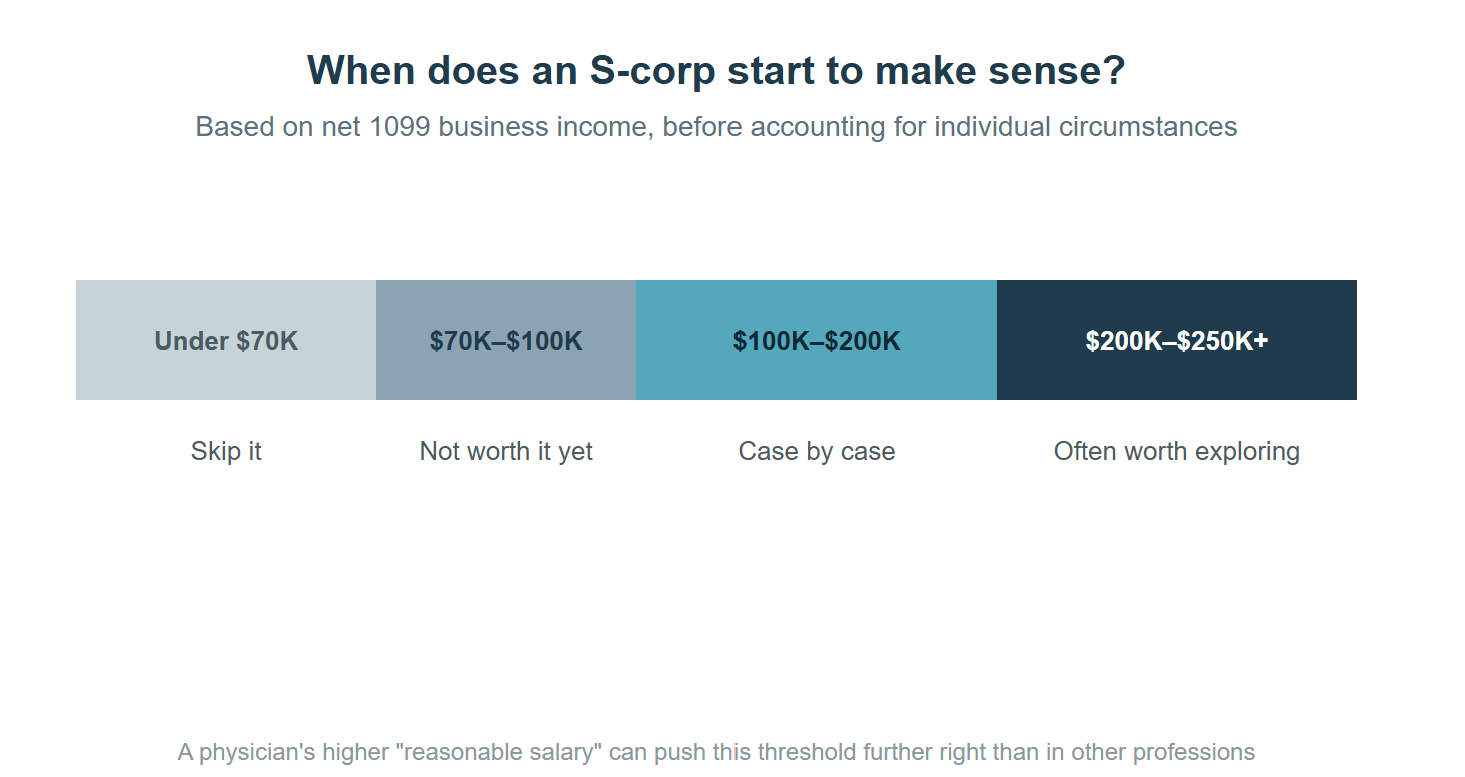
As a rough guide: under roughly $70,000 in net business income, an S-corp isn't worth the trouble. Below $100,000, it's typically not even part of the conversation. Things tend to start making sense somewhere in the $200,000 to $250,000-plus range, though this is genuinely case by case, and it's worth noting that a physician's "reasonable salary" tends to run higher than in most professions, which compresses the benefit of splitting income between salary and distributions. On top of that, an S-corp adds real cost: payroll administration and higher tax prep fees, often at least $2,000 a year more than a simpler setup.
We'd also gently push back on a lot of the tax advice circulating on physician social media right now. Ideas like deducting your student loan payments because you wouldn't be a physician without them sound plausible, but they don't hold up, and getting flagged for something like that isn't a minor inconvenience. If it sounds too good to be true, it's worth a second opinion from your own CPA before you act on it.
For a broader look at what's actually deductible, we've written more about tax deductions for 1099 physicians, and about the wider picture of physician side gigs and how to structure them. If you want a general (non-physician-specific) primer on how the IRS treats self-employment income this year, Kiplinger's self-employed tax guide is a solid outside resource.
Bookkeeping isn't optional, even though it feels like it should be
If there's one piece of this that physicians consistently underestimate, it's bookkeeping. It's tempting to treat it like a minor chore, which is exactly why it tends to get skipped or done inconsistently.
We think of it a lot like cleaning your own house. Some people are genuinely disciplined about staying on top of it. For everyone else, it quietly gets messier over time. At a minimum, if you have consistent 1099 income, get comfortable with something like QuickBooks. If you can't realistically carve out an hour or two a month to keep it organized, pay someone, using the same hourly-rate logic you'd apply to anything else. Expect that to run somewhere in the $300 to $600 a month range, which sounds steep until you weigh it against the alternative: missed deductions and a much rougher tax season. S-corp status adds even more to track, more moving parts, more basis to follow, and it's exactly the kind of thing that catches physicians off guard in their first year of filing.
There's a real upside to hiring the right professional here beyond convenience. If your accountant or bookkeeper makes a mistake, they're generally on the hook to fix it, and many carry insurance for that reason. If you're doing it yourself and make the same mistake, you own the taxes, the interest, and the penalties that follow.
The bottom line
None of this is meant to talk you out of a side hustle or moonlighting. Extra income is genuinely available, and for the right physician, in the right season, it can meaningfully move the needle on debt payoff, retirement savings, and lifetime taxes. We just don't want you making that decision off the highlight reel. Run the real numbers, including your time. Know what you're giving up from your W-2 benefits before you compare offers. And build the structure, EIN, LLC, bookkeeping, retirement accounts, in the order that actually fits your income, not the order social media makes it sound like everyone else is doing it.
The best of the best list is a paid sponsorship, but these are professionals/companies that Tyler and Chad collaborate with within their own practices or have been vetted to earn a spot on this list. By supporting our sponsors, it allows Chad & Tyler to dedicate more time to you and the Physician Cents community. If you ever have a question (or not a great experience, which we don’t expect!) about a sponsor, please let us know. We call it the “best of the best” for a reason, and we will maintain that standard for our listeners & viewers.
This information is for general purposes only. This information is not intended to be a substitute for specific professional financial, tax, or legal advice, as individual circumstances vary. Please see a financial professional, CPA, and/or an attorney in regards to your own individual situation.
Wealthkeel’s Advisory Services and Financial Planning offered through Vicus Capital, Inc., a Federally Registered Investment Advisor. WealthKeel LLC, 615 Channelside Drive, Suite 207, Tampa, FL 33602 -- 267.590.9533.
Olson Consulting LLC, Offering Advisory Services and Financial Planning, is a State-Registered Investment Advisor.
Listen Now:
A podcast designed specifically for physicians, offering a breakdown of complex financial topics to help you develop your financial IQ, further your financial journey, and improve your well-being. Whether you're a medical student, resident, fellow, or attending physician, you're sure to learn something new that will benefit your journey.
.png)

.png)

