The Pre-Retirement Playbook: Top 5 Moves & The Tax Bomb; Part 1
October 15, 2026
Welcome to the latest episode of the Physician Cents Podcast, where we explore complex financial topics tailored specifically for physicians. Whether you're a medical student, resident, fellow, or attending physician, you're going to find valuable insights that can help you increase your financial IQ, further your financial journey, and improve your overall well-being. Hosted by Chad Chubb and Tyler Olson, let’s dive in!
Watch this episode instead (Don’t forget to subscribe 🙏):
Listen to this episode instead (Once you love it (we know you will 😉), please leave us a review):
🚨 Looking for help with Disability Insurance, Physician Banking, Student Loan Refinancing, Physician Mortgages, Contract Reviews, and more? Check out our "Best of the Best" sponsors page to find a list of the professionals Chad & Tyler team up with for their clients.
The Pre-Retirement Playbook: Top 5 Moves & The Tax Bomb; Part 1
For most physicians, the retirement savings advice is simple: you're in a high bracket, so max out your pre-tax accounts. Your 403(b), 457(b), 401(k), and maybe a cash balance plan all get funded, year after year, for two or three decades.
It's good advice. But it comes with a bill that doesn't arrive until your 70s. Once required minimum distributions begin, the IRS forces money out of those accounts every year, and every dollar is taxed as ordinary income. For physicians with large pre-tax balances, that can mean paying as much tax in retirement as you did while working. We call it the RMD tax bomb.
The good news: it's one of the most plannable problems in retirement. This guide covers how RMDs work, how to tell whether you have a problem, and five pre-retirement planning moves that can shrink the bill, including Roth conversions for physicians and protecting yourself from sequence of returns risk.
What Is an RMD (Required Minimum Distribution)?
A required minimum distribution (RMD) is the minimum amount the IRS requires you to withdraw each year from pre-tax retirement accounts once you reach a certain age. You got a tax break when the money went in. RMDs are how the IRS eventually collects its share.
Which accounts are subject to RMDs?
Traditional and rollover IRAs
SEP IRAs
Pre-tax 401(k), solo 401(k), and 401(a) accounts
Pre-tax 403(b) accounts
Governmental 457(b) accounts (yes, these count too, though many physicians roll them into an IRA before RMD age)
Roth IRAs have no RMDs for the original owner, and since 2024, Roth 401(k) and Roth 403(b) accounts no longer require them either.
When do RMDs start?
Under the SECURE 2.0 Act, your RMD starting age depends on your birth year:
Born 1951 to 1959: RMDs begin at age 73.
Born 1960 or later: RMDs begin at age 75.
For most physicians currently in mid-career or late career, that means age 75.
How is your RMD calculated?
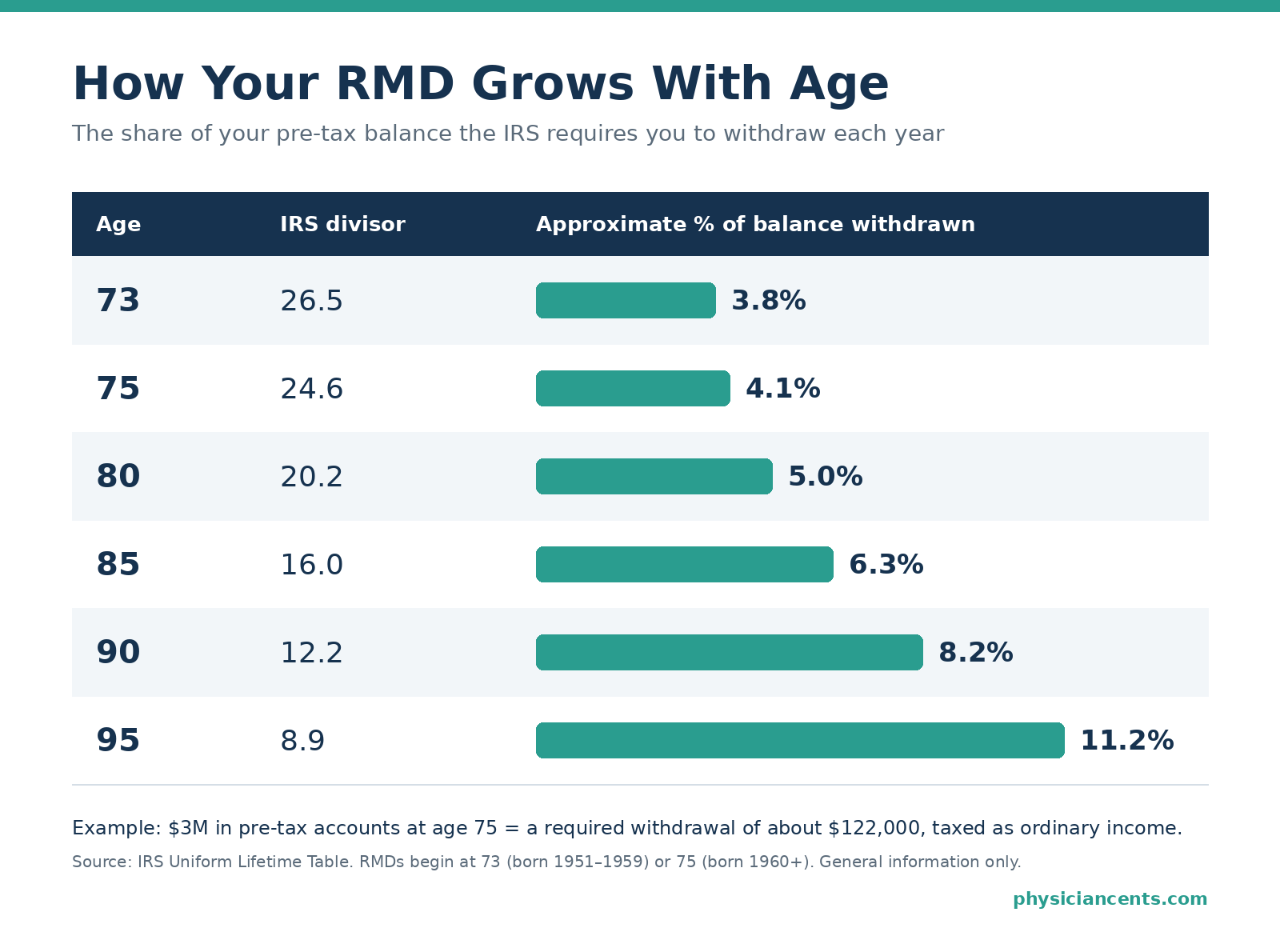
Your RMD is based on two factors: your prior year-end pre-tax balance and your age. The IRS divides your balance by a life expectancy factor, so the required percentage climbs every year.
Pre-tax contributions don't save taxes. They defer them. That deferral is a great deal when you contribute at 35% and withdraw at 22%. It's a much worse deal when large balances force you to withdraw at the same rate you contributed.
Physicians are especially exposed for three reasons:
High savings rates: Decades of maxed-out 403(b), 457(b), and cash balance contributions create very large pre-tax balances.
Long compounding runway: Money contributed in your 40s and 50s often grows for 25+ years before RMDs start.
Little Roth or taxable savings: Many physicians had "too much income" for direct Roth contributions and never built a large brokerage account.
A worked example
Consider a hypothetical married physician couple. They retire at 65 with $4 million in pre-tax accounts, a modest taxable account, and very little in Roth. They live on taxable savings for a few years and leave the pre-tax money alone.
At 6% annual growth, that $4 million grows to roughly $7.2 million by age 75.
Their first RMD at 75 is roughly $291,000, all taxed as ordinary income.
Add Social Security, and their taxable income lands well into the 24% bracket, plus Medicare IRMAA surcharges.
If one spouse dies, the survivor files as single. The same income now falls into the 35% bracket, often called the widow's penalty.
Whatever is left passes to their children, who generally must empty an inherited IRA within 10 years, frequently during their own peak earning years.
Now look at the years between 65 and 75. While they lived on taxable savings, their taxable income was low, often in the 12% or 22% bracket. That stretch is the retirement tax valley: low taxes after you stop working, then a steep climb once RMDs begin. Those low-bracket years are the single biggest opportunity in this entire plan, and most physicians let them pass without acting.
Example is hypothetical, rounded, and based on 2026 tax brackets for illustration only.
Do You Actually Have an RMD Problem?
Not every physician needs to worry. RMDs start at roughly 4% of your balance, which is close to a common sustainable withdrawal rate. If your planned spending already requires that much income, your RMD may simply fund the retirement you intended.
You're more likely to face an RMD tax bomb if any of these apply:
Most of your retirement savings are pre-tax, with little in Roth or taxable accounts
Your projected pre-tax balance at RMD age is several times your annual spending need
You expect a pension, Social Security, or part-time income alongside RMDs
You live well below your means and won't need the full RMD to cover expenses
You hope to leave significant retirement assets to your children
You're married and want to protect a surviving spouse from higher single-filer brackets
If you checked two or more, the rest of this guide is worth a careful read.
5 Pre-Retirement Moves to Defuse the RMD Tax Bomb
These moves build on each other. A projection tells you whether you have a problem. Roth conversions are the main fix. Flexible savings buckets make conversions possible. Smart sequencing protects the plan from bad market timing. And an updated estate plan makes sure the strategy carries through to your family.
1. Model your future RMDs before you retire
You can't fix a problem you haven't measured. A good retirement projection estimates your pre-tax balance at RMD age, the resulting distributions, and your tax bracket every year from retirement through your 90s.
A useful projection includes:
Current balances by tax type (pre-tax, Roth, taxable, cash)
Expected retirement date and any part-time or consulting income
Social Security and pension start dates
Realistic growth, inflation, and longevity assumptions
Year-by-year tax brackets, IRMAA tiers, and RMD amounts
This is the one area where even confident DIY physicians benefit from a second set of eyes. The math isn't hard, but the number of moving parts is, and errors compound over decades. On the podcast, Tyler, an Enrolled Agent who works in this world daily, said he plans to hire help for his own decumulation planning. A one-time or hourly review can be enough.
The same caution applies to AI tools. They're great for learning concepts and preparing questions. But if you can't independently verify a projection's output, you shouldn't make irreversible decisions based on it.
2. Use Roth conversions to fill your low-tax years
A Roth conversion moves money from a pre-tax account into a Roth IRA. You pay income tax on the converted amount that year, and the money then grows tax-free with no RMDs.
The goal is to pay tax at today's lower rate instead of tomorrow's higher one. As Tyler put it on the show: we don't time the market, but we do time Roth conversions.
The best conversion windows for physicians include:
Years at reduced FTE or part-time
The "tax valley" between retirement and RMDs
A sabbatical or gap between positions
Any year with unusually low income
How to size a conversion: Most strategies convert just enough each year to "fill up" a target bracket, such as the top of the 22% or 24% bracket, without spilling into the next. Spreading conversions across several years usually beats one large conversion.
Watch for these side effects:
IRMAA: Conversions count as income for Medicare premiums, using a two-year lookback. Conversions at 63 can raise premiums at 65.
Estimated taxes: A large conversion can trigger an underpayment penalty. Plan a quarterly estimated payment in the same quarter.
Don't confuse it with a backdoor Roth. A backdoor Roth is a small annual contribution strategy. A Roth conversion is a multi-year tax strategy for large pre-tax balances.
3. Build flexible savings buckets: taxable, Roth, and cash
A Roth conversion creates a tax bill on purpose, so you need a way to pay it. The best source is cash or a taxable brokerage account.
Avoid withholding the tax from the conversion itself. That shrinks the amount that reaches the Roth and undercuts the strategy. Paying from another IRA adds more taxable income, and pulling from a Roth defeats the purpose.
That's why tax diversification matters throughout your career:
Pre-tax reduces your tax bill during high-earning years.
Roth gives you tax-free income and flexibility in retirement.
Taxable funds conversion taxes and bridges the gap years before Social Security and RMDs.
An advanced tactic: Taxable accounts generate long-term capital gains (taxed at 0%, 15%, or 20%) and potentially the 3.8% Net Investment Income Tax. If you have a multi-year conversion runway, consider alternating years: convert in some years and realize capital gains in others. You can also convert late in the year and sell taxable assets in January to pay the bill, keeping the gains out of the high-income conversion year.
Tax-loss harvesting during your working years helps here too. Banked losses can offset gains you'll realize later. For more ideas like these, see these year-end tax strategies for high-income households.
4. Protect against sequence of returns risk
Sequence of returns risk is the danger that a major market drop just before or after you retire permanently reduces how long your savings last. A 30% decline is far more damaging when you're withdrawing than when you're still contributing.
The highest-risk window is roughly three to five years on either side of your retirement date. To manage it:
Start de-risking about five years out. Gradually shift from stocks to bonds so you enter retirement in a cautious position.
Keep near-term spending in stable assets. Hold the first few years of withdrawals in cash or short-term Treasuries.
Use asset location. Hold bonds in pre-tax accounts and keep taxable accounts in low-dividend stock funds to limit annual tax drag.
Revisit risk after the danger zone. Once you're several years into retirement, some retirees can reasonably add risk back, since fewer years of income need protecting.
5. Update your estate, insurance, and legacy plan
Your RMD strategy is also an estate strategy. Before retirement, review:
Wills, trusts, powers of attorney, and healthcare directives
Beneficiary designations on every retirement and insurance account
Long-term care coverage, including hybrid policies
Medicare and supplemental coverage
Charitable giving plans, including qualified charitable distributions (QCDs) once eligible
Be honest about your legacy goals. If you plan to leave significant assets to your children, Roth conversions do double duty. They reduce your own RMDs and give your heirs tax-free money instead of a 10-year tax bill.
Your RMD Game Plan by Career Stage
RMD planning isn't only for physicians nearing retirement. The earlier you start, the more options you have.
Medical students and residents: Your training years are your lowest-income years. Prioritize Roth contributions now, because every Roth dollar is one less dollar subject to RMDs later.
Early-career attendings: Keep using pre-tax accounts while you're in a high bracket, but start a taxable brokerage account alongside them. It becomes your Roth conversion fund decades from now.
Mid-career physicians: Run your first projection that includes RMDs. If your pre-tax balances look on track to become very large, identify your likely conversion windows now.
Late-career physicians: Model your RMDs, map out conversion years, start de-risking about five years before retirement, and update your estate plan.
7 Common RMD Planning Mistakes
Assuming pre-tax contributions save taxes instead of deferring them
Letting the low-tax years between retirement and RMDs pass without converting
Having no cash or taxable account to pay conversion taxes
Withholding conversion taxes from the converted amount
Skipping estimated tax payments after a large conversion
Ignoring IRMAA when sizing conversions near Medicare age
Trusting a projection you can't verify
Frequently Asked Questions About RMDs for Physicians
At what age do RMDs start?
RMDs start at age 73 if you were born between 1951 and 1959, and at age 75 if you were born in 1960 or later.
Do 457(b) plans have required minimum distributions?
Yes. Governmental 457(b) plans are subject to RMDs, just like 403(b) and 401(k) plans.
How can physicians reduce RMDs?
The most effective strategy is converting pre-tax money to Roth during lower-income years before RMDs begin. Building Roth and taxable savings during your career also helps. Once eligible, qualified charitable distributions (QCDs) can satisfy RMDs without adding to taxable income.
Should I pay Roth conversion taxes from the IRA?
Generally, no. Paying from cash or a taxable account keeps more money growing tax-free in the Roth.
What is sequence of returns risk?
It's the risk that poor market returns early in retirement permanently reduce how long your savings last, because you're withdrawing while values are down.
This post is based on Part 1 of our pre-retirement mailbag series, where we answer a listener's question about the late-career playbook. In Part 2, we cover drawdown strategies like QCDs and QLACs, which accounts to pull from first, and the most common pitfalls we see. Looking for more tools and recommendations? Check out our Best of the Best resources page.
The best of the best list is a paid sponsorship, but these are professionals/companies that Tyler and Chad collaborate with within their own practices or have been vetted to earn a spot on this list. By supporting our sponsors, it allows Chad & Tyler to dedicate more time to you and the Physician Cents community. If you ever have a question (or not a great experience, which we don’t expect!) about a sponsor, please let us know. We call it the “best of the best” for a reason, and we will maintain that standard for our listeners & viewers.
This information is for general purposes only. This information is not intended to be a substitute for specific professional financial, tax, or legal advice, as individual circumstances vary. Please see a financial professional, CPA, and/or an attorney in regards to your own individual situation.
Wealthkeel’s Advisory Services and Financial Planning offered through Vicus Capital, Inc., a Federally Registered Investment Advisor. WealthKeel LLC, 615 Channelside Drive, Suite 207, Tampa, FL 33602 -- 267.590.9533.
Olson Consulting LLC, Offering Advisory Services and Financial Planning, is a State-Registered Investment Advisor.
Listen Now:
A podcast designed specifically for physicians, offering a breakdown of complex financial topics to help you develop your financial IQ, further your financial journey, and improve your well-being. Whether you're a medical student, resident, fellow, or attending physician, you're sure to learn something new that will benefit your journey.