How Doctors Can Achieve Financial Freedom: 12 Essential Steps (Part 3)
January 15, 2026
Welcome to the latest episode of the Physician Cents Podcast, where we explore complex financial topics tailored specifically for physicians. Whether you're a medical student, resident, fellow, or attending physician, you're going to find valuable insights that can help you increase your financial IQ, further your financial journey, and improve your overall well-being. Hosted by Chad Chubb and Tyler Olson, let’s dive in!
Watch this episode instead (Don’t forget to subscribe 🙏):
Listen to this episode instead (Once you love it (we know you will 😉), please leave us a review):
🚨 Looking for help with Disability Insurance, Physician Banking, Student Loan Refinancing, Physician Mortgages, Contract Reviews, and more? Check out our "Best of the Best" sponsors page to find a list of the professionals Chad & Tyler team up with for their clients.
How Physicians Can Reach Financial Freedom in 15–20 Years (Part 3: Steps 9-12)
You finish training, your attending paycheck finally hits, and suddenly the numbers in your bank account look completely different.
This is the moment where a lot of physicians accidentally choose between two very different futures:
A path to financial independence in 15 to 20 years
Or a life at 40 with a boat, two BMWs, a seven-figure mortgage, and absolutely zero freedom
This post is Part 3 of a three-part (Read Part 1 Here & Part 2 Here) series based on a wildly popular tweet thread from financial planner Tyler Olson, co-host of the Physician Cents podcast. The idea is simple: if you want freedom on your terms, your first few years out of training matter a lot more than you think.
Here, we are walking through Steps 9-12 of his 12-step framework so you can build a rock-solid foundation without feeling like you have to live like a resident forever.
Let’s start with why this whole thing blew up in the first place.
Why This 12-Step Money Plan Hit a Nerve With Physicians
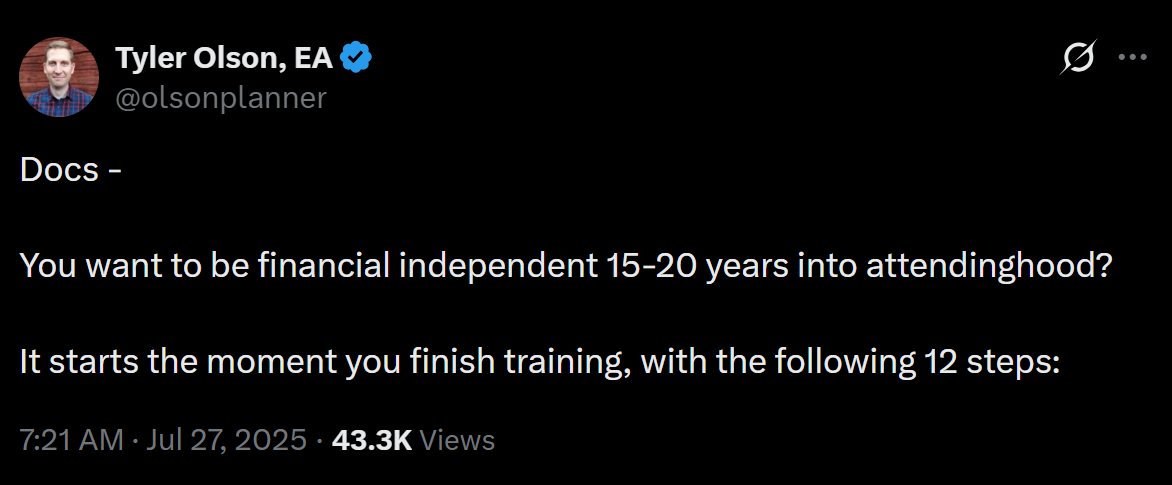
On July 27, Tyler posted a thread that started like this:
“Docs, you want to be financially independent 15 to 20 years into attendinghood. It starts the moment you finish training with these following 12 steps.”
The response was huge:
Over 43,000 views
Close to 500 bookmarks
Around 300 likes
When the bookmarks beat the likes by that much, that tells you something. People are not just casually liking it, they are saving it because it hurts a little and feels very real.
So why did this particular thread hit so hard?
Over the past year, Tyler has talked about meeting more physicians in their 50s who are coming in with big incomes, big houses, big cars, and very small financial freedom. Some of them:
Need to work into their 70s
Or sell their home and uproot their lives in their 50s
All because the early years after training were spent in “I earned it” mode instead of “I’m building my future” mode.
One of the most memorable lines from that thread was this:
“You can build generational wealth in these next three years or wake up at 40 with a boat, two BMWs, a million-dollar mortgage, and zero freedom.”
So, how do you pick the first option? You start with Step 1.
Financial Freedom for Physicians (Steps 9 to 12): Doctor House, Adulting, Contracts, Future
You finally hit attending-hood, the paycheck jumps, and your brain immediately starts making a wish list. House. Car. Trips. Maybe something ridiculous like a boat. (No judgment. Just a raised eyebrow.)
This is the part where a lot of physicians accidentally make early decisions that are hard to unwind later. The good news is you don’t need exotic strategies to build financial independence. You need order, patience, and a few boring grown-up moves that quietly protect you.
These four steps are about avoiding expensive traps, getting your legal basics handled, protecting your work life with a smart contract review, and building a future that doesn’t get sacrificed to shiny stuff in years 1 to 3.
Step 9: Avoid the “doctor house” disaster
Your first year as an attending is not the time to buy your forever home.
That line makes people mad. It also saves people from five-figure mistakes.
A lot of new attendings are emotionally ready to “settle down.” After a decade-plus of med school and training, it makes total sense. You want roots. You want stability. You want a place that feels like yours.
The problem is that buying a home can lock you into a life you haven’t actually lived yet.
“Rent, stack cash. But once you are stable, 12 to 24 months at least.”
Why renting first can save your sanity (and your options)
Buying a home early can backfire for reasons that have nothing to do with being “bad at money.” It’s more basic than that. You’re still learning your real life.
Here’s what can change fast in year 1:
Your job might change. You might realize the group is not a fit, the hospital culture is rough, or the work is not what you expected.
Your call schedule might be brutal. It’s hard to judge the long-term impact of call until you live it for a while.
You might hate the city (or just the lifestyle). A place can look perfect on paper and feel wrong once you’re there.
You might be in the right city but the wrong neighborhood. Even a small move can become expensive once you’ve bought.
A lot of the “doctor house” problem is this: buying a big home becomes a way to force stability. Like, “If we buy the house, we’ll make it work.”
The hidden cost of buying too soon (closing costs are not cute)
Even when everything goes fine, buying and selling real estate is expensive.
The discussion highlighted a few numbers worth keeping in your head:
Closing costs are often quoted around 2.5 to 3%, and you’ll also hear broader ranges like 2 to 5% depending on the state and deal.
When you sell, you may pay a realtor commission (often discussed as 5 to 6% on the sales side).
A common rule of thumb is that the break-even time on a home purchase is around five years.
So if you buy, realize you need to move (job, call, burnout, family needs), and sell within a couple of years, you can get hit twice.
Could a hot market bail you out? Sure. Could a cooling market punish you? Also sure. The point is you’re taking a big risk before you even know if you like the job and the place.
The exceptions (yes, there are real ones)
If you’re moving back home, staying in the same area you trained in, or joining a job where you already know the schedule and the culture, buying sooner can make sense.
But for the common scenario (new job, new city, new everything), renting buys you something extremely valuable: time to confirm you’re in the right spot.
A practical twist mentioned that’s easy to overlook: you can keep your rental flexible too. A six-month lease or other short-term option can give you room to adjust without getting stuck paying for a place you’re ready to leave.
This is the part where everyone groans. Then they put it off. Then five years pass.
“Adult paperwork” isn’t about being ultra-wealthy. It’s about protecting yourself and the people you care about if something goes wrong. And yes, that includes physicians who are single with no kids.
The core documents discussed were:
A will
A health care directive (often includes a living will)
Powers of attorney (medical and financial)
Beneficiary designations (the sneaky one people forget)
The paperwork is uncomfortable for a reason
A living will can be emotionally hard to walk through. But the alternative is worse.
If your loved ones ever had to make major medical decisions without guidance, that’s a heavy burden. Writing down your wishes is a way to take that weight off them.
The classic horror story is the old beneficiary that never got updated after a marriage change. Another common scenario is someone listing parents early on, then never revisiting the plan once life changes.
You don’t need to obsess over this monthly. You do need to review it when big life events happen.
For a lawyer-written explanation of the core documents (health care proxy, living will, power of attorney, will), this breakdown is useful: three essential estate planning documents.
How to actually get it done
The most important part is momentum. Don’t wait for the perfect time.
The episode mentioned a few common ways physicians handle this:
Hire a local attorney to draft the basics.
Use an employer open enrollment legal benefit, if available, to get starter documents in place.
Work with a specialized team when your situation is more complex.
However you do it, the point is the same: doing this paperwork is a form of love for the people who would otherwise have to guess.
The episode called out a common line from employers: “Don’t worry, it’s boilerplate.”
That’s usually code for “please sign this quickly.”
Even if a place truly won’t negotiate, you still need to know what you’re agreeing to, because it shapes your life: schedule, call, compensation structure, and how easy it is to leave if the job turns out to be a bad fit.
RVU targets: What you’re expected to produce, and what happens if you don’t.
Call coverage: How often, what kind, and whether it changes after the first year.
Non-competes: Restrictions on where you can work if you leave.
Tail coverage: If you have claims-made malpractice insurance, tail coverage is what protects you for claims filed after you leave a job for work done while you were there.
There’s also a practical “life planning” reason to do this early: once you understand your real schedule and obligations, you can make smarter decisions about housing, commuting, childcare, and whether that “perfect neighborhood” actually fits the day-to-day.
Paying for a review is not a luxury
The episode gave a simple comparison that sticks:
An $800 contract review can save you $50,000 in headaches, wasted time, and costly fixes.
That could come from compensation misunderstandings, call expectations that weren’t clear, or benefits that weren’t what you assumed. And even if nothing changes, you walk away understanding what you signed, which is the minimum standard for something this important.
The hosts also pointed listeners to their network of vetted professionals, including contract review help. If you want to explore that ecosystem, start here: Physician Cents planning resources and links.
Step 12: Build your future, not just your present
This is the one that decides everything.
Years 1 through 3 as an attending can feel like a release valve. You’ve been underpaid for years, you’ve delayed life, and now you can finally buy the stuff you’ve been staring at since residency.
The episode didn’t say “never buy fun things.” It said build in the right order.
The simplest version:
In years 1 to 3, prioritize retirement, debt payoff, emergency reserves, and a small fun budget. Once those are locked in, then we can talk about the boat, the Tesla, the ski condo, whatever.
And yes, the Tesla came up as a “splurge” example. Not because it’s the most expensive car on earth, but because it’s often bought as a want, not a pure utility purchase. There was also a real-world note that cold weather can reduce battery efficiency, which matters if you need it to function as your main car in winter.
A clean priority order for your early attending dollars
Here’s the framework discussed, in plain language:
Retirement contributions: You want time in the market. That’s where compounding gets its power.
Student loan plan and payoff: Whether you’re paying aggressively or pursuing forgiveness, get a strategy you can live with.
Emergency reserves: It’s hard to feel calm without cash on hand.
A small fun budget: Fun is allowed. It just shouldn’t come first.
One detail that matters here: when student loans are finally gone (or your required payment drops), it can feel like a whole new world opens up. That’s when lifestyle creep can hit hardest, because it feels like “extra money.”
“Save first, spend what’s left” is a happiness hack
A big theme was systems. Not perfect willpower.
If you build a process where retirement, debt, and reserves happen first, you don’t have to micromanage every discretionary purchase. You can spend what’s left without guilt because the important goals were funded upfront.
They also gave a simple compounding example that’s worth repeating: earning 10% on $700 doesn’t feel life-changing. Earning 10% on $1,000,000 does. Same rate, totally different impact.
The early habits are what get you to the bigger base later.
If you want to keep up with Tyler Olson’s work and thoughts in real time, you can follow Tyler Olson on Twitter. For Chad Chubb’s updates and planning commentary, you can follow Chad Chubb on Twitter.
Keep the splurges, just earn them
The episode tossed out a few “present” purchases that people tend to reach for:
A Tesla
A boat (or a second boat, apparently)
A ski condo
A status car (the kind you buy because you want it, not because you need it)
The underlying message wasn’t moralizing. It was practical.
If your values say “boats matter,” fine. If your values say “travel matters,” fine. Just don’t build a life where future-you is stuck paying for past-you’s impulse buys.
Conclusion
The fastest way to build financial freedom as a physician isn’t a secret investment. It’s avoiding expensive early mistakes, getting the boring paperwork done, and protecting your work life with a contract you actually understand. Rent until you’re stable, handle the estate basics, pay for a contract review, and build the foundation before the toys. Take it one step at a time, stay modest, and ask for help when you need it. Your future financial independence will feel a lot less stressful when the basics are already handled.
Thanks for reading. If you want more physician-focused money content, you can check out WealthKeel LLC for more from Chad or connect with Tyler through Olson Consulting LLC.
The best of the best list is a paid sponsorship, but these are professionals/companies that Tyler and Chad collaborate with within their own practices or have been vetted to earn a spot on this list. By supporting our sponsors, it allows Chad & Tyler to dedicate more time to you and the Physician Cents community. If you ever have a question (or not a great experience, which we don’t expect!) about a sponsor, please let us know. We call it the “best of the best” for a reason, and we will maintain that standard for our listeners & viewers.
This information is for general purposes only. This information is not intended to be a substitute for specific professional financial, tax, or legal advice, as individual circumstances vary. Please see a financial professional, CPA, and/or an attorney in regards to your own individual situation.
Wealthkeel’s Advisory Services and Financial Planning offered through Vicus Capital, Inc., a Federally Registered Investment Advisor. WealthKeel LLC, 615 Channelside Drive, Suite 207, Tampa, FL 33602 -- 267.590.9533.
Olson Consulting LLC, Offering Advisory Services and Financial Planning, is a State-Registered Investment Advisor.
Listen Now:
A podcast designed specifically for physicians, offering a breakdown of complex financial topics to help you develop your financial IQ, further your financial journey, and improve your well-being. Whether you're a medical student, resident, fellow, or attending physician, you're sure to learn something new that will benefit your journey.
.png)
.png)

