The Pre-Retirement Playbook: Top 5 Moves & The Tax Bomb; Part 2
November 1, 2026
Welcome to the latest episode of the Physician Cents Podcast, where we explore complex financial topics tailored specifically for physicians. Whether you're a medical student, resident, fellow, or attending physician, you're going to find valuable insights that can help you increase your financial IQ, further your financial journey, and improve your overall well-being. Hosted by Chad Chubb and Tyler Olson, let’s dive in!
Watch this episode instead (Don’t forget to subscribe 🙏):
Listen to this episode instead (Once you love it (we know you will 😉), please leave us a review):
🚨 Looking for help with Disability Insurance, Physician Banking, Student Loan Refinancing, Physician Mortgages, Contract Reviews, and more? Check out our "Best of the Best" sponsors page to find a list of the professionals Chad & Tyler team up with for their clients.
The Pre-Retirement Playbook: Withdrawal Strategies, QCDs & QLACs; Part 2
For decades, your financial plan had one job: build savings. Retirement flips that job. Now the question is how to turn those savings into income you can count on, without handing more to the IRS than you need to and without running out of money.
That’s what retirement withdrawal strategies for physicians are all about. In Part 1 of the Pre-Retirement Playbook, we covered the RMD tax bomb and the five moves to make before you retire. In Part 2, we move into the drawdown years. We’ll look at which accounts to pull from first, how Roth conversions and required minimum distributions (RMDs) fit together, when a qualified charitable distribution (QCD) or a QLAC makes sense, and how IRMAA can quietly change the math.
There’s no one-size-fits-all answer here. Your best approach depends on the mix of accounts you’ve built and your tax picture. What follows is a framework that gives you more control.
Key Takeaways
Coordinate your withdrawals. Pull from taxable, tax-deferred, and Roth accounts on purpose, so you control your taxable income and keep flexibility.
Skip the universal withdrawal order. The right sequence depends on your account mix, spending needs, and expected income.
Plan for RMDs years before they arrive. Don’t wait for the first distribution to figure out how to pay for it.
Treat Roth conversions as a multi-year tradeoff. You pay tax today in exchange for potential tax savings later.
Build in flexibility. Plan withdrawals around reliable spending needs, with room to adjust for market drops and life changes.
What Is a Retirement Withdrawal Strategy?
A retirement withdrawal strategy is a plan for which accounts you draw income from, in what order, and in what amounts each year. A good one balances three things at once:
Income for spending. It covers what you actually need to live on.
Taxes on withdrawals. Different accounts are taxed very differently when money comes out.
Market risk. It limits how much you have to sell when markets are down.
For physicians, the details matter more than usual. Most of us retire with savings spread across a 403(b), a 457(b), maybe a cash balance plan, IRAs, a brokerage account, and some Roth dollars. Each one plays a different role.
Which Accounts Should Physicians Withdraw From First?
Understand your three tax buckets
Taxable (brokerage) accounts. Withdrawals don’t add an IRA distribution to your taxable income. Selling investments may still create capital gains, often at favorable long-term rates. These accounts are also the ideal source for paying Roth conversion taxes.
Pre-tax accounts (403(b), 401(k), 457(b), traditional IRA). These provide income, but every dollar withdrawn is generally taxed as ordinary income.
Roth accounts. Qualified withdrawals are tax-free, and there are no RMDs for the original owner. That flexibility makes many households save Roth dollars for later in retirement or for heirs.
Why the “conventional order” isn’t a rule
You’ve probably heard the classic sequence: spend taxable first, then pre-tax, then Roth. It’s a reasonable starting point, but following it blindly can backfire. If you live only on taxable savings for a decade, your pre-tax accounts keep growing untouched. That sets up larger RMDs later, which is exactly the tax bomb we covered in Part 1.
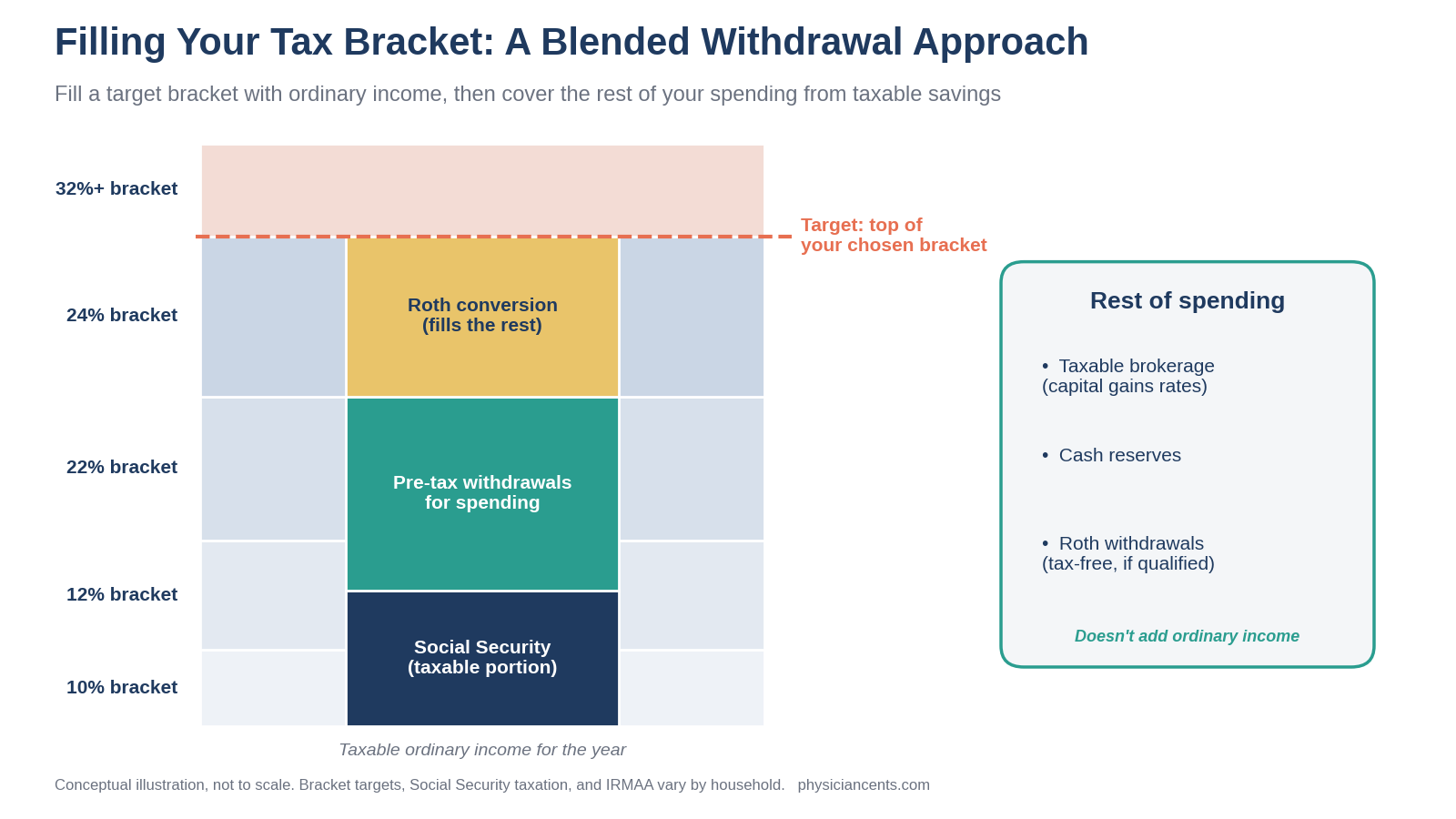
Many physicians do better with a blended approach:
Estimate your spending need for the year.
Identify your target tax bracket, such as the top of the 22% or 24% bracket.
Fill that bracket with pre-tax withdrawals or Roth conversions.
Cover the rest of your spending from taxable savings.
Use Roth dollars strategically, for a large one-time expense or a year when you want to keep reported income low.
Blending also helps with market risk. When stocks are down, you can pull from bonds, cash, or whichever account holds the assets that haven’t fallen, instead of being forced to sell stocks at a loss. For a deeper look at how withdrawal sequencing works with asset location and Roth conversions, see these tax-smart moves for a stronger retirement.
How to Plan Roth Conversions Before RMDs Begin
A Roth conversion moves money from a pre-tax account into a Roth IRA. You pay income tax on the converted amount now, and future qualified withdrawals are tax-free.
The window between retirement and RMD age, which we called the “tax valley” in Part 1, is often the best time to convert. Spreading conversions across several years usually beats one large conversion that pushes you into a higher bracket. That said, conversions don’t guarantee lower lifetime taxes. The right call depends on your current and future income, tax rates, and goals.
Before converting each year:
Estimate the conversion amount and the tax bill before you act, not after.
Pay the tax from taxable savings when possible, rather than withholding it from the conversion.
Know the five-year rules. If you’re under 59½, each conversion has its own five-year clock for avoiding the 10% penalty on converted amounts. Roth earnings have a separate five-year requirement for tax-free withdrawals.
Avoid trying to time the perfect year. Waiting for a market dip or a tax law change can leave you with fewer years to spread conversions across.
The better approach is a repeatable annual review. Each year, look at your income, account balances, expected spending, tax brackets, and Medicare costs. Then decide whether a conversion fits this year’s plan and how much to convert. As Tyler said in Part 1, we don’t time the market, but we do time Roth conversions.
How to Handle Required Minimum Distributions Without Surprises
Forecast your RMDs early, then decide in advance which assets you’ll sell to satisfy them. Where you take each RMD from depends on the account type:
Traditional IRAs: You can generally calculate the RMD for each IRA, add them up, and take the total from one or more of your IRAs.
403(b)s: These can also be aggregated with each other, but not with your IRAs.
401(k)s and 457(b)s: These generally require a separate RMD from each plan.
Many physicians consolidate old workplace plans into an IRA before RMD age for exactly this reason. Fewer accounts means fewer separate RMDs to track.
Can you use an RMD to fund a Roth conversion?
No. Your RMD must come out first, and it can’t be converted to a Roth. Once you’ve satisfied the RMD, you can convert additional pre-tax dollars, which are taxable that year.
What Is a Qualified Charitable Distribution (QCD)?
A qualified charitable distribution (QCD) is a direct transfer from your IRA to an eligible charity, available once you’re at least 70½. For charitably minded physicians, it’s one of the most efficient giving tools available.
Why QCDs matter:
A QCD can count toward your IRA’s RMD.
The amount is generally excluded from your taxable income.
Lower reported income can also help with IRMAA and other income-based thresholds.
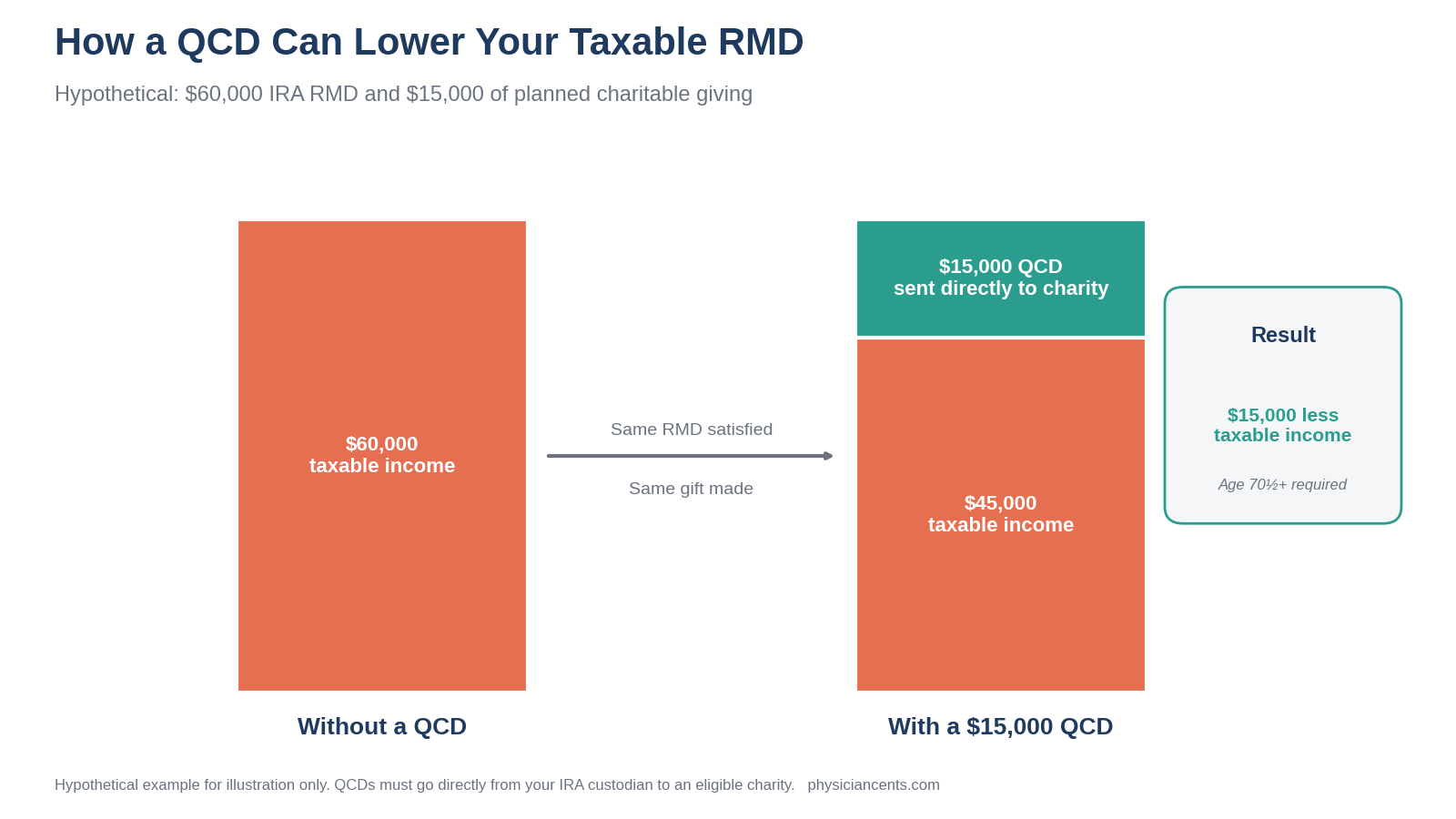
Hypothetical example: Your IRA RMD this year is $60,000, and you normally give $15,000 to charity. If you send $15,000 directly from your IRA to the charity as a QCD, only $45,000 of your RMD shows up as taxable income. Your giving stays the same, and your taxable income goes down.
Get the details right:
The money must go directly from your IRA custodian to the charity, not through you.
Complete the QCD before you’ve withdrawn the rest of your RMD for the year.
Donor-advised funds generally aren’t eligible QCD recipients.
Keep the charity’s written acknowledgment for your records.
What Is a QLAC, and Should Physicians Consider One?
A qualified longevity annuity contract (QLAC) is a deferred annuity bought with eligible retirement funds. It provides guaranteed income later in life. Under current rules, the amount used to buy it can be excluded from RMD calculations until payments begin, up to an IRS limit.
Potential pros:
Guaranteed income that can cover essential expenses late in retirement
Protection against longevity risk, the risk of outliving your savings
A smaller RMD base until payments start
Potential cons:
The money is much less accessible once it’s committed
Costs, features, and payout terms vary widely between contracts
Survivor options affect what a spouse or beneficiary receives
Inflation can erode the value of fixed future payments
When a QLAC may make sense: You’re worried about longevity, you don’t have a pension, and you want a guaranteed floor of income in your 80s and beyond. Even then, it’s one option to compare alongside Social Security timing, bond ladders, and your other investments.
How IRMAA Fits Into Your Withdrawal and Conversion Decisions
IRMAA (Medicare’s income-related monthly adjustment amount) is a surcharge on Part B and Part D premiums for higher-income retirees. It generally uses your tax return from two years earlier. That means a Roth conversion at 63 can raise your Medicare premiums at 65.
Before converting, estimate the full cost of the move: federal tax, state tax, and any added Medicare premiums. A conversion that looks attractive based on brackets alone may cost more once IRMAA enters the picture.
But here’s the part physicians often miss: don’t avoid IRMAA at all costs. Paying a surcharge for a few years can be far cheaper than letting pre-tax balances grow into larger RMDs, which may trigger higher IRMAA tiers for many years later. Kiplinger has a helpful breakdown of why avoiding IRMAA can actually cost you more in retirement. Make the decision using the full plan, not one premium threshold.
Planning for the Pre-Medicare Gap and Survivor Needs
Budget for health insurance before 65
Retiring before Medicare eligibility can leave a costly gap. Coverage may come from a former employer, a spouse’s plan, or the Health Insurance Marketplace. Get actual premium quotes before you set a retirement date. If you’re using the Marketplace, remember that premium subsidies are tied to your income, so large conversions or withdrawals can affect those costs too.
Plan for higher spending early on as well. The first years of retirement are often when physicians travel and pursue hobbies the most. For more on budgeting realistically for healthcare and spending, see these retirement mistakes that could cost you millions.
Prepare for a surviving spouse
When one spouse dies, the survivor typically moves to single filing status, often with similar income but narrower tax brackets. Social Security and pension income may change too.
Talk through this now:
Review beneficiary designations and account titles.
Keep account, insurance, and login information where both spouses can find it.
Make sure the less financially involved spouse knows how to pay bills and contact each institution.
It’s not a fun conversation, but it’s one of the most valuable ones you can have.
5 Common Retirement Withdrawal Mistakes
Waiting until RMDs are close to model them. Early projections give you years to adjust.
Converting too much in one year. Large conversions can push income into higher brackets and IRMAA tiers.
Waiting for the “perfect” conversion year. Indecision quietly shrinks your conversion window.
Assuming an IRA withdrawal covers your 401(k) or 457(b) RMD. It doesn’t.
Treating your first retirement budget as permanent. Review the plan as health, markets, and family circumstances change.
What This Means for You as a Physician
Residents and early-career attendings: Build all three tax buckets now. Roth and taxable dollars give your future self options.
Mid-career physicians: Run a projection that includes future RMDs and identify your likely conversion windows.
Late-career physicians: Map out your withdrawal order, conversion amounts, pre-Medicare coverage, and charitable plans before your last day of work.
Recently retired physicians: Make an annual review a habit. Revisit conversions, RMD forecasts, and IRMAA every year.
Frequently Asked Questions
What is the best withdrawal order in retirement for physicians?
There isn’t a universal one. Many physicians blend withdrawals, filling a target tax bracket with pre-tax withdrawals or Roth conversions and covering the rest of their spending from taxable savings.
When can I spend money from a Roth conversion?
It depends on your age, how long your Roth IRA has been open, and whether you’re withdrawing converted principal or earnings. If you’re under 59½, each conversion has its own five-year period for penalty-free access.
Does a QCD replace my regular charitable giving?
No. A QCD is one way to give from an IRA. You can keep giving cash, appreciated stock, or through a donor-advised fund as usual.
Should I avoid IRMAA at all costs?
No. Compare the surcharge with the long-term tax savings from lower future RMDs. Sometimes paying IRMAA is the better deal.
The Bottom Line
A sustainable retirement withdrawal strategy coordinates your accounts, taxes, healthcare costs, and household needs. No single account or rule can do all the work. Revisit your projections every year, and bring in qualified professionals for the decisions that depend on your specific tax situation. The strongest plan is one you can adjust as life changes.
The best of the best list is a paid sponsorship, but these are professionals/companies that Tyler and Chad collaborate with within their own practices or have been vetted to earn a spot on this list. By supporting our sponsors, it allows Chad & Tyler to dedicate more time to you and the Physician Cents community. If you ever have a question (or not a great experience, which we don’t expect!) about a sponsor, please let us know. We call it the “best of the best” for a reason, and we will maintain that standard for our listeners & viewers.
This information is for general purposes only. This information is not intended to be a substitute for specific professional financial, tax, or legal advice, as individual circumstances vary. Please see a financial professional, CPA, and/or an attorney in regards to your own individual situation.
Wealthkeel’s Advisory Services and Financial Planning offered through Vicus Capital, Inc., a Federally Registered Investment Advisor. WealthKeel LLC, 615 Channelside Drive, Suite 207, Tampa, FL 33602 -- 267.590.9533.
Olson Consulting LLC, Offering Advisory Services and Financial Planning, is a State-Registered Investment Advisor.
Listen Now:
A podcast designed specifically for physicians, offering a breakdown of complex financial topics to help you develop your financial IQ, further your financial journey, and improve your well-being. Whether you're a medical student, resident, fellow, or attending physician, you're sure to learn something new that will benefit your journey.